Archive for July, 2011

post thumbnail

The Bomb, The Fire and the Caves: New Mexico and Science Fiction

Nora Reed Heineman-Fleck lives in Albuquerque, New Mexico where she plays with bismuth and meteorites for Mama’s Minerals. By night she thinks really hard about bombs, villains and the hairstyles of video game heroines and makes bad art. She can be found on Tumblr and Twitter.


Image by Flickr user Larry1732, CC-BY

My state is on fire and I’m thinking about science fiction.

A flashback: here I am in 2000– I know it’s 2000 because I watched some of the news coverage of the fire from the airport in Albuquerque, waiting for a plane to come in, so it’s pre-9-11. The Cerro Grande fire is sweeping across northern New Mexico; threatening– and eventually burning– homes. The sky at sunset is a brilliant orange and the smoke in the air doesn’t hurt my lungs so much as make me aware of them in a way I usually am not unless I am running or otherwise exerting myself.

And I could be rewriting history a bit here, to make this a better story, but when I think about it, that orange fire is one of those weird New Mexican experiences that primed me for strangeness– that is, for science fiction.

I’m going to make a bold claim here, and that is that New Mexico is the most science fictional place in the world. We have the landscape for it. Carlsbad Caverns is such a strange, alien environment that going inside the caves feels like entering the mouth of a living planet, saliva drip-drip-dripping from it’s immensely slow but menacing jaws. Jim White, discoverer of the caverns, thought that he was descending into hell as he explored them, and areas like Devil’s Spring and the Boneyard still hold somewhat dire names. White Sands National Monument, a bit northeast of Carlsbad, is miles of sand dunes big enough to hold plenty of worms or fremen; the dunes move around constantly and so creating roads is difficult. The last time I drove past White Sands the dunes had shifted and overtaken the fence between the highway and the National Monument.

But it’s not just the landscape. The atomic bomb is from here, and the more I learn about the Manhattan Project the more it feels like a fabricated story. Oppenheimer is said to be the father of the atomic bomb, but really he’s just the only person in the world that rolled high enough Intelligence, Wisdom and Charisma scores to manage the top secret, international community of scientists that the US Government hid away on a hill in the New Mexican desert. Read a bit about the stories of the creation of the bomb and they all feel like fiction– the Soviet spies meeting surreptitiously in Albuquerque, confirming their identities with matched halves of a Jell-O box, Richard Feynman learning to open locked cabinets containing nuclear secrets, even Oppenheimer’s iconic “I am become death” quote, and you’ll feel like you’re reading the notes and ephermera of a rather eclectic world of science fiction.

Radiation is worked into the soil here, more metaphorically then physically. It’s always weird to talk to about nukes with people from out of state because nuclear weapons are a little bit personal here. I don’t work at the lab, but you can’t throw a stone around here without finding someone who does; growing up it was one of those standard professions you knew some of your friends’ parents have.

It’s not just the labs, though. We have the only facility in the country for holding nuclear waste in the Waste Isolation Pilot Plant; where radioactive waste is stored in salt mines that will grow around it until it’s encased in salt; it won’t be safe for 10,000 years. How do you warn future generations about that? By burying multiple “information rooms” and discs of granite, aluminum oxide, and fired clay in multiple languages, of course. It’s like they were building reality to make better fodder for post-apocalyptic novels.

New Mexico has the second largest deposits of uranium ore in the country and a controversial history of lung cancer in miners. You know that episode of Firefly where they go to the mining town and everyone has a lung disease? It’s a little like that, except the lung disease is cancer. We don’t have any operational mines now, but the boom-bust cycle of those mining towns is worked into Grants, New Mexico and won’t probably ever come out.

And that’s just the solid facts about radiation; the rumors are something else. Stories about forests where you shouldn’t eat the game because it’s too radioactive, places where you shouldn’t breathe in the dust you kick up because there’s uranium in it. We’re seeing it now; the Los Conchas fire seems to be making Twitter vibrate with anticipation that Area G will catch fire and release radioactive smoke into the air.

While I’m on rumors, let me veer off of radiation and point out Roswell, just a couple hours’ drive north from WIPP– another staple of science fiction lore, right in my little state; a town economically dependent on an accident with a weather balloon that happened over half a century ago. Roswell is an icon, almost a point of pilgrimage, a town that feels like living in a broadcast of Coast to Coast AM.

And what all these places have in common is that it’s the stories of them, the rumors, the people, that make them such rich fodder for the sci-fi imagination: the dunes overtaking the fence, the superhuman charisma and intelligence of Robert Oppenheimer, Carlsbad Caverns as an entry into hell and the buried tablets for future generations above WIPP, the radioactive smoke and soil. There comes a certain point where the rumors, the speculation and the truth all combine and create this strange atomic culture. That’s the air New Mexico breathes, and we’re all a little alien, a little nuclear, as a result.

post thumbnail

EP303: Leech Run

 
icon for podpress  EP303 [37:04m]: Play Now | Play in Popup | Download

By Scott W. Baker
Read by: Alasdair Stuart
Originally appearing in Zero Gravity: Adventures in Deep Space – Released July 27!
Discuss on our forums.
All stories by Scott W. Baker
All stories read by Alasdair Stuart

Rated appropriate for mid-teens and up for violence and mild adult language.

Leech Run
by Scott W. Baker

The inhabitants of Galileo Station parted as Titan moved among them. Not one made eye contact, but all gawked furtively. One of Titan’s dark eyes glared back down at the throng; the other eye remained hidden behind a curtain of stark white hair. Conspicuous appearance was his curse. What bystander would forget a snow-capped mountain of dark muscle? Memorability was not an asset for someone like him.

One body in the crowd moved toward Titan rather than away. “The passengers is aboard, love,” the man said.

“Reif, call me ‘love’ in public and you’ll find yourself very uncomfortable.” Titan lowered his voice so it stayed within the wide berth granted by the populace. “How many passengers?”

“Thirty-two, lo — Captain.”

Titan shook his head. “Hemingway promised fifty.”

“If Hem flew so bad as he scored cargo–”

“Any load of leeches will turn a profit,” Titan assured the mechanic. “But small load doesn’t mean small risk. I want you sharp.”

“As ever, love.”

They continued through the bustling station to their ship, a little cargo runner designed for intra-system transport at sub-light speeds. Of course, a mechanic of Reif’s skill could make a ship reach speeds its designers never fathomed.

Such deviant engineering demanded a pilot with a select set of skills and dubious moral character. Hemingway possessed both. He was waiting for them beside the ship with his ever-present, boastful grin.

“I said there be takers on Galileo, didn’t I?” Hemingway said as his crewmates entered earshot. “I done already told them the rules.”

Titan’s brow furrowed. “Thirty-two? Don’t dislocate anything patting yourself on the back. And there’s just one rule on my ship.”

Titan brushed past his pilot into the cargo hold. It was a small hold, even for an intra-system runner, but it hadn’t always been so. Reif’s touch here made for ideal leech transport. The customized hold maintained a six-foot buffer from all electrical systems, enough of a gap that even a class-three leech couldn’t siphon a single ampere. Despite his extensive precautions, Titan always felt uneasy with such capricious cargo.

post thumbnail

EP302: Flash Extravaganza

 
icon for podpress  EP302 [35:59m]: Play Now | Play in Popup | Download

Winners of our 2010 Flash Contest!
London Iron by William R. Halliar (narrator Andrew Richardson)
Wheels of Blue Stilton by Nicholas J. Carter (narrator Christian Brady)
Light and Lies by Gideon Fostick (narrator- Mur Lafferty)
All Escape Pod Originals!
And we end with a grand “It’s Storytime” montage put together by Marshal Latham!
Discuss on our forums.

post thumbnail

Book Review: “Osama” by Lavie Tidhar

It’s been about ten years since Al Qaeda operatives flew jets into three U.S. buildings (and were thwarted before they could hit a fourth). In that time we’ve all suffered the effects, which is to say: a couple of wars, a lot of political punditry, the unfortunate rise of Sean Hannity, and the end of flying for fun thanks to security theater (at least, in the U.S., where I live). I think it’s safe to say that most people wish the bombings had been nothing but a story, a book they could read and then put down again.

In Lavie Tidhar’s new novel Osama, that’s exactly the world the characters inhabit.

Osama is the story of Joe, a private detective residing in Vientaine (in Laos), who is commissioned by a mysterious woman to find a man named Mike Longshott. What makes Longshott special is this: he is the author of a series of pulp novels entitled Osama bin Laden: Vigilante. With a nearly unlimited line of credit, courtesy of his employer, Joe travels to Paris, London, and elsewhere in search of the mysterious author, only to find his way blocked by false leads and government agents who kick the crap out of him.

Despite being a short novel — under 300 pages — it took me a while to finish the book because it just didn’t draw me in. I’m usually a fan of alternate history — both in short and long form, from Pullman to Turtledove and beyond — but my issue with Osama was that, while a Turtledove novel (for example) will pick a single point in history to change, I was never really sure what was different about Osama — or, even, when it took place. If the book shows a world where Bin Laden didn’t commit or mastermind terrorist acts, then I clearly don’t know enough about the history and impact of the man, pre 9/11, to comprehend what might have changed because he didn’t exist. That was a major sticking point for me while reading the novel, and someone better versed in recent history might not have that problem*.

Osama did have a lot of rich scenery — Tidhar is a well-traveled writer who has lived in many locations worldwide, and as such he has a wealth of experience to draw on in creating an Osama-free world. He also changed enough about that world that, if it was supposed to be contemporary to our own, readers are forced to wonder just how much technological advancement was driven by terrorism (or violence in general). The big difference was that no one used computers. And, as for air travel, things were very different in Joe’s world: he is still allowed to smoke on airplanes, non-first-class passengers get meals, and if there is any airport security to speak of, I completely missed it.

I generally read books for enjoyment, not enrichment — although I don’t mind being required to think or project my knowledge to get the full benefit of a book. However, I think that, to enjoy (or even fully appreciate) Osama, readers have to engage far more critical thinking skills than I really felt was necessary. I had to fill in too many expository gaps and I’m not even sure I did that correctly. While well-written, the story, though straightforward, didn’t keep me as interested and engaged as I think it could have done.

You may enjoy this book, especially if you like alternate history or are a student of (or commentator upon) current events. But it wasn’t the book for me.

#

Special thanks to the author for providing a review copy.

Note to parents: this book contains violence and adult subject matter. Plus, if younger readers don’t have more than just a passing familiarity with terrorist acts beyond 9/11, they may find themselves lost. Of course, you should use your own discretion when it comes to your children.

#

* The first time I was truly exposed to the name Osama Bin Laden was the morning of 9/11 — I was working on a morning radio show and we saw the video of the first tower just after the first plane hit it. The host, a Lebanese-American, took one look and (off-air) said “Osama Bin Laden”.

post thumbnail

Science Future: Harking Hugos

Science fiction inspires the world around us. It inspires our future. To discover these influences, we look to the future of science, to Science Future. The Science Future series presents the bleeding edge of scientific discovery and links it back to science fiction in order to discuss these influences and speculate on the future of science fiction.

Harking Hugos

Each year the Noble Prizes are given out to people who have achieved great things in their life. They is given out to people who have furthered the advancement of the fields of science and the humanities and represent great personal achievements for both the recipients and society. Like science, science fiction has its own award called the Hugo Awards, given yearly to the best science fiction stories. As regular listeners may know, Escape Pod has a tradition of presenting the short stories nominated for the Hugo Awards and keeping in theme with the celebration of the Hugo Awards, Science Future is going to present scientific breakthroughs that relate to the Hugo nominated short stories and novellas presented here on Escape Pod.

Artificial Intelligence is something science fiction has dreamed about since the first computer was built. The story Want of a Nail By Mary Robinette Kowal introduces us to an artificial intelligence that lives as a guardian of the memories of a human family traveling the stars. This artificial intelligence acts the family’s historian, both selecting and storing important events for the family to remember. Modern computers couldn’t hope to perform such a complex task, at least not without a major breakthrough, which it may have created at the University of Exeter. Researchers have created a processor which copies how the human brain processes information. The human brain doesn’t differentiate between processing and collecting information like current computer processors and but this new one  uses phase-changing materials that allows it to both process and store data at the same time.

It is not certain, however, that we’ll ever create a true artificial being but science fiction has presented us with other options for our electronic creations such as implanting them in their own bodies. In the story Plus or Minus By James Patrick Kelly deep space explorers have augmentations which allow them to communicate with simple thought alone. Today we are limited to using external devices such as cellphones to communicate with people beyond the range of our physical presence but the University of Michigan has taken steps to fix that with the BioBolt. The BioBolt is a minimally invasive brain implant which is placed on the skull and is connected to a small film of microcircuits that rests on the brain and listens to neurons. Since the entire device is under the skin with nothing sticking out, the chances of infection are greatly reduced. In order to communicate it uses the electrical field produced by skin to transmit to any other device touching the skin, creating a simple way for the brain to be listened to without wires sticking out of the skin.
An entirely new and wondrous place will open up to us the day we can think at each other and be heard. This world will be full of exciting possibilities like direct knowledge transference, language-less communication, and body hacking! Oh wait, we already have that last one. A joint effort by the University of Tokyo, Japan, and Sony Computer Science Laboratories have created the PossessedHand project which has produced a device which lets someone hijack another person’s hand movements. It does this by directly lightly shocking the muscles in the arm allowing people to program a sequence of specific finger movements. The device doesn’t work perfectly yet it does successfully control the fingers of another human being, which is hauntingly familiar to one of Hugo nominees, The Things by By Peter Watts. In The Things creatures find it easy to control the bodies of the humans they find but like the controllers of the PossessedHand project, they can not fathom their prey’s minds.

The creatures in The Things embodied the idea of self-preservation not by fight or flight but with breeding. The ability to breed is also one of the main themes of the story Amaryllis by Carrie Vaughn. In Amaryllis a woman is born to a society where food is strictly rationed and therefore the act of breeding is also tightly controlled. The ability to give birth to a child is something perhaps too undervalued in the modern day except by doctors at the University of Gothenburg’s Sahlgrenska Hospital in Sweden. There doctors are preparing to attempt to complete the first successful transplant of a human womb. Among the subjects under review include a fifty six year old woman who is donating her womb to her twenty five year old daughter.

The miracles and breakthroughs envisioned and brought to us by science  and science fiction all deserve our appreciation regardless of any awards given. Congratulations to all the Hugo Award nominees.

Literature that keeps employing new linguistic and formal modes of expression to draft a panorama of society as a whole while at the same time exposing it, tearing the masks from its face – for me that would be deserving of an award.Elfriede Jelinek

post thumbnail

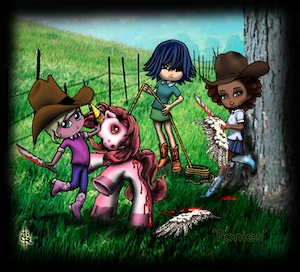
One more Hugo post- Ponies

We didn’t have the rights to Ponies, by Kij Johnson, but we wanted you to have a chance to experience it, so we’re linking to the Tor.com story and reading of it. Ponies is about, well, ponies, but also about little girls growing up, and the darkness that can entail. Dark. Oh so dark…

And we have some art by Skeet Scienski!

That does it for the Escape Pod Hugo offerings. To recap:

Short story:
The Things, by Peter Watts
For Want of a Nail, by Mary Robinette Kowal
Amaryllis, by Carrie Vaughm
Ponies, by Kij Johnson (Link to Tor.com)

Novelette:
Plus or Minus, by James Patrick Kelly
Eight Miles, by Sean McMullen (link to author’s site)
The Emperor of Mars, by Allen Steele (link to author’s site)
The Jaguar House, in Shadow, by Aliette de Bodard (link to author’s site)
The Leviathan, Whom Thou Hast Made, by Eric James Stone (link to author’s site)

(Apologies all around for my mistake in saying Stone Wall Truth was a Hugo nominated story. Instead it was nominated for the Nebula this year.)

post thumbnail

Update on The Alphabet Quartet

Sorry for the delay, folks. Here’s a note from AQ wrangler, Dave:

Hey all,

Dave Thompson here.

Just wanted to let everyone know that the Alphabet Quartet is coming, but it looks like it’s going to be coming a little bit later than we’d originally hoped.

I am sincerely sorry for the delay – we’d hoped to get it to you by the beginning of July. That said, I’ve put a lot of time into it, as has Wilson Fowlie (who is working as the sound producer), and we don’t want to give something unless we’re completely happy with it.

As I said, it is coming, and it should be coming soon. I’ll definitely keep you all updated as to when you can expect it.

Thanks for your patience. I’m looking forward to sharing all these stories with you.

post thumbnail

EP301: Stone Wall Truth

By Caroline Yoachim
Read by: Heather Welliver
Originally appearing in Asimov’s
Discuss on our forums.
All stories by Caroline Yoachim
All stories read by Heather Welliver
Nominated for the Hugo Nebula Award for Novelette, 2011

Rated appropriate for older teens and up for adult imagery.

Stone Wall Truth
by Caroline M. Yoachim

Njeri sewed the woman together with hairs from a zebra tail. Her deer-bone needle dipped under the woman’s skin and bobbed back out. The contrast of the white seams against her dark skin was striking.

“The center seam makes a straight line,” Njeri told her apprentice, “but the others flow with the natural curves of the body, just as the Enshai River follows the curve of the landscape.”

Odion leaned in to examine her work, his breath warm on the back of her neck. Foolish boy, wasting his attention on her. Njeri set her needle on the table and stood up to stretch. The job was nearly done — she’d repositioned the woman’s organs, reconstructed her muscles, sewn her body back together. Only the face was still open, facial muscles splayed out in all directions from the woman’s skull like an exotic flower in full bloom.

“Why sew them back together, after the wall?” Odion asked. “Why not let them die?”

post thumbnail

EP300: We Go Back

 
icon for podpress  Ep300 [44:29m]: Play Now | Play in Popup | Download

By Tim Pratt
Read by: Mur Lafferty
An Escape Pod original!
Discuss on our forums.
All stories by Tim Pratt
All stories read by Mur Lafferty

Rated appropriate for younger teens and up – occasional adult language.

Episode 300! Wow!

We Go Back
Tim Pratt

My best friend Jenny Kay climbed in through my window and nearly stepped on my head. If I’d been sleeping a foot closer to the wall, I would’ve gotten a face full of her boot, but instead I just snapped awake and said “What who what now?” and blinked a lot.

“Oh damn,” Jenny said in a loudish whisper. “When did you move your bed under the window?”

“Last week,” I said, sitting up in bed. “I wanted a change.” If you can’t rearrange your life, you can at least rearrange yourself, and if your mom won’t let you dye your hair blue, you can make do with rearranging your rooms.

Jenny Kay dropped from standing to sitting in one motion, making my mattress bounce, and landed cross-legged and totally comfortable. “Hey,” she said. “So I need to borrow your ring.” I couldn’t read her expression in the dim moonlight from the window.

I looked at my right hand, where a thin silver ring looped my index finger, catching what light there was in the room and giving back twinkles. The metal grew cold against my skin and tightened a fraction, almost a friendly little squeeze. The ring — which wasn’t really a ring — could tell when I was thinking about it. “Uh,” I said.

Jenny nodded vigorously, a motion I felt in the jostling of the mattress more than I saw. “I know! I know. But I wouldn’t ask if it wasn’t important. I mean, you’ve had the thing for more than a year, and I’ve never asked once if I could use it, right?”

I glanced at my closed door — no glow under the crack at the bottom, which meant my parents had gone to their separate beds and turned out the hall light — and switched on my bedside lamp. Jenny was dressed in jeans and a sweater, all in dark grays and blacks, not her usual aggressively flamboyant colorful mishmash style at all. Good for sneaking into people’s windows, I guessed.

I sat up against the headboard, because when you’re about to annoy your best friend, it’s better not to be flat on your back at the time. “I wish I could,” I said — not one hundred percent true, but Jenny was a fourteen-year-old genius, not a human lie detector. “But it’s, like… part of me. You know? I’m part of the mechanism. I can’t just take it off. It’s linked into my, what’s it called, socratic nervous system?”

“Somatic,” Jenny said gloomily. She was almost as good at biology as she was at math. “The part of your nervous system that controls movement, which sort of halfway makes sense, I guess.”

I shrugged. “So, there you go. The ring’s not something I wear. It’s something that wears me. Or we wear each other. What did you want it for?”

post thumbnail

Book Review: “Pirates” by Nobilis Reed

For the first few seasons of Star Trek: Deep Space Nine*, many critics said it was boring because they had no starship and couldn’t go anywhere. Though there were glimmers of greatness, the show didn’t get really good until after Worf and the Defiant arrived.

That’s kind of how I felt about Pirates, Nobilis Reed’s follow-up to Scouts.

WARNING: Pirates is a novel for adults, and as a result the review contains discussions of explicit sex. Reader discretion is advised. Also, this review contains spoilers for Scouts.