

Escape Pod 1072: The Gliese Referendum (Democratic Futures)
Show Notes
Matthew Taber Hanson
https://loft.org/artists/matthew-taber-hanson
Alethea Kontis
Adam Pracht
https://escapepod.org/people/adam-pracht/
Alasdair Stuart
https://alasdairstuart.com/the-full-lid/
The Story of Tonight from Hamilton
https://www.youtube.com/watch?v=66W9gG_kZS8&list=RD66W9gG_kZS8&start_radio=1
Star Trek: Discovery Episode 205: Saints of Imperfection
https://memory-alpha.fandom.com/wiki/Saints_of_Imperfection_(episode)
Voidmerch store
https://voidmerch.threadless.com/collections/escape-artists-inc-x-voidmerch-1
The Gliese Referendum
By Matthew Taber-Hanson
Monday
Everyone on Aeneas remembers the night when the pictures of Gliese came back. Dad ran the Astronomy department, so he was working late. When he left that morning he was beaming. “Today’s the day!” He gave me a quick squeeze, and I averted my eyes as he kissed Mom for far too long.
Monday evening, Mom and I sat on the couch, undyed linen cushions on a bamboo frame. We watched our ancient Earth-made TV with the black spray of dead pixels across the lower left. An animated graphic of the probe approached the star system. The probe had whizzed by Gliese two years ago, and was now in the inky void of space, but the pictures and data were only now reaching us. Speed of light. If there’s one thing ingrained into us Aeneans, it’s how much emptiness exists between those tiny specs of light.
The pictures came, and the pictures were glorious. White swirls dancing across a backdrop of blue. It looked like the photographs of Earth the first generation took as they left the cradle of humanity. They wanted us to know where we came from. Now, we knew where we were going.
It’s funny how little the first generation knew about Gliese when they signed us all up for this 140-plus-year mission. They knew Gliese had water vapor. Big deal. So does Venus. When we saw those pictures, we knew there was liquid water. Oceans.
Mom and I squealed and hugged each other. “Look Elsy, our new home,” she said.
I tried to stay up until Dad came home but fell asleep on the couch. I half-woke in the middle of my parents’ conversation. Their words rolled over me, sound without meaning, until a grimness in my mother’s tone snapped me into focus.
“What’s wrong?” she said.
I cracked my eyes open, Mom put her arms around Dad’s waist and pulled him close.
Dad rested his head on Mom’s shoulder. “It’s a water world.”
“I know. I saw the images. Isn’t—”
“No, I mean the whole thing. Ice at the poles. Liquid oceans everywhere else. There’s no land.”
“That’s… not ideal.” Mom’s voice took on the tone she used when placating obstinate constituents. “But I’m sure we can come up with solutions.”
Dad let go of Mom’s embrace and took a step back.
“I thought… don’t you see… we can’t settle there. We have to keep going.”
My heart sank. I hadn’t considered that we wouldn’t settle on Gliese. Sure, I knew there were backup plans. We could head to Wolf, but that would take another hundred years. “What’s going on?”
“Nothing, Elsy.” Dad tousled my hair. I was too tired to resist. “It’s late, we should all get to bed.”
Tuesday
I refused to regret my late night even as my alarm screeched. The only thing preventing me from hitting snooze was knowing I’d be mocked mercilessly if I missed the start of the harvest.
I was in the first year of my apprenticeship. Agriculture production specialist, or as we called ourselves: farmers. I loved it. Starting with the right soil, planting a tiny seed, seeing the shoots push their way through the dirt. Most of all, I loved the harvest. I loved biting into tomatoes or peas I’d pulled from a plant seconds ago, knowing we kept Aeneas alive.
We were harvesting potatoes. Most of it was done by drones, but there’s a tradition that every harvest we each dig out one plant by hand. Not with a shovel, with our literal hands.
That day was my first potato dig. As the newbie, the dozen other farmers circled around me as I sank my fingers into the warm, gritty earth. I felt a moment of horror as I scooped up only handfuls of crumbling brown dirt. Then my fingers met the smooth skin of a tuber. A giddy rush surged through me as I brushed the dirt away and saw the pale red skin of my first potato. I plucked it from the earth and held it up as the other farmers cheered. I was one of them.
I discovered another potato below the first. Then another and another. Seven potatoes in all. I felt like a kid digging up pirate gold.
“Good plant. It’s a good sign,” said Ashby. He was two years older than me, and just finished his own apprenticeship, but had a confident charisma that already made him a big deal among the farmers.
And he was cute. He was tall and trim with short-cropped brown hair and soulful brown eyes.
The other farmers picked a plant and started digging. They worked at the same time. I’d been the center of attention because I was the newbie. When they’d finished, we compared our harvests. It was a competition, but the criteria were flexible. The most potatoes, the largest potato, the greatest overall mass, or whatever conditions helped you win.
Then we split off to do practical farm work. I shadowed Ashby as he oversaw the drone harvesters that dug up the rest of the potatoes, though they mostly managed themselves. Less thrilling than digging by hand, but far more efficient. While the drones worked, Ashby told me how he’d adapted some drone code last year. He’d done a short apprenticeship with Information Technology; they wanted him to stay, but his parents were farmers, and his heart was here.
For lunch we ate mashed potatoes, the same ones we’d dug up hours before, with a potato from each of our personal harvests, boiled and smashed together with garlic and rosemary.
I marveled at how I’d turned dirt, water, and light into the warm starchy meal. Others topped the potatoes with chili, but I reveled in the potatoes as we sat around our communal table.
“The chili has Gliese tomatoes,” said the cook. They were grown in the test garden that simulated Gliese’s atmosphere and the light from its star. The star, inconveniently, was also called Gliese, along with a hundred other stars, because Earth astronomers were boring at naming things.
The mention of Gliese of course turned conversation to the probe.
“Water!”
“Oceans!”
“Crops in Gliese’s soil!”
“It’ll take decades to make the soil compatible.”
“Maybe we can domesticate some native plants.”
I sat and listened and the warmth inside turned sour. I remembered what Dad said last night, ‘No land.’ You can’t grow potatoes in the sea. I thought about telling the other farmers, but didn’t want to crush their joy.
After a few more hours monitoring drones, Ashby asked, “A bunch of us are watching the Council meeting together. Should be more about Gliese. You want to come?”
I twisted the hem of my shirt. I wanted to spend the evening with Ashby, but… “I kind of… promised, I’d be there in person?”
“Right,” chimed in another farmer. “Forgot your mom was a big shot Councilor.”
“And grandma,” chimed in a third. “Hey Elsy, I requested more nitrate, but maybe you could ask your folks?”
“Lay off, guys,” Ashby said to the other farmers. He smiled at me, and butterflies fluttered in my stomach. “They’re just teasing. Support your family. See you tomorrow.”
“You’ve all seen the pictures of Gliese.” Dad stood at the speaker’s podium. The seven members of the Council sat behind a wide wooden table. Another hundred of us sat opposite them, filling the room to capacity. Thousands more streamed at home or work. “You’ve seen that Gliese is covered with liquid water.”
The crowd erupted in applause. Dad winced and put up his hands. “What you haven’t seen is land, because there is none.”
Murmurs spread through the crowd.
“That is why, with a heavy heart, the Astronomy Division recommends we alter course to…” Dad stopped as the murmurs grew to a roar.
“Order!” Mom banged her gavel. I bet she was thrilled to use it. “Order!” Eventually the crowd quieted. “Of course the Council welcomes Astronomy’s input, but surely we can solve this. We can dredge the ocean floor to make islands, or create floating settlements from the Aeneas.”
“We’re not taking apart Aeneas,” Grandma said. She sat two spots down from Mom. I pitied the poor councilor between them.
“Thank you, Councilor Cortez-Wright.” Mom’s voice took on the icy edge it so often did with Grandma. “But recycling parts of Aeneas to construct habitat on Gliese was part of the first generation’s plan.”
“With all due respect Councilor, they’re dead. I’m not.” Not yet went unspoken. She was sixty four. She’d be eighty four when we reached Gliese.
“It’s not just the water on Gilese,” Dad said. “Wolf has gravity and orbital period more similar to Earth.”
“But Gliese is still well within the acceptable range,” Mom countered.
From the end of the table, Councilor Sharp asked, “You know what planet has gravity, orbit, temperature, water, land, and everything similar to Earth?”
“Earth!” chorused a dozen voices in the audience.
Mom, Dad, and Grandma rolled their eyes. If anything could unite them, it was the Earthers. Earthers were a minority on Aeneas, but a big enough minority to elect a Counsilor.
The Council went back and forth and around in circles for another half-hour, until Grandma said, “This issue’s too big for the seven of us to decide. I move we make a ship-wide referendum.” This drew a round of applause from the audience. The rest of the Council agreed—in principle—but for something this high stakes, they scrutinized every detail.
“Earth should be on the ballot.”
“Only if we rank our votes.”
“I prefer approval voting.”
When they got to scheduling, Dad asked for the floor. “The vote needs to be soon. If the decision is for Gliese, we need to start decelerating in no less than ten days.” It would take twenty years to slow down enough to enter Gliese orbit; we were going that fast. And once we slowed down, there wouldn’t be enough fuel to accelerate back to our current speed. If we wanted to leave Gliese, it would take thousands of years traveling in a ship meant to last five hundred. Whatever we decided, there was no going back.
“Very well,” Mom said. “To give time for counting and preparations, I propose we hold the referendum this Sunday.”
“Second.”
“In favor?” All seven counselors. The date was set.
Sunday.
I was three weeks from my eighteenth birthday; I’d barely miss being eligible. It wasn’t fair. My generation would settle the planet—or not settle it. We deserved a say.
“I want to vote.”
“Excuse me?” Mom said.
I hadn’t realized I’d spoken out loud. “Nothing.”
But it was too late. Grandma locked eyes with me. “Approach the podium and state your name for the record.”
I wanted to pull my head into my sweater or sneak out of the room, but I knew not to argue with Grandma. I walked to the podium where Dad had stood minutes ago. “I’m Elsabeth Cortez-Shapiro, and I said… I want to vote?”
“You’re seventeen,” Mom said.
“I know, Councilor Cortez-Johnson.” It bugged Mom when I called her that at home, but she couldn’t do anything about it here. I was miffed she pointed out my age, like I was still a child.
I didn’t want to be in front of that crowd, but backing down would be worse. “We should expand the voting age. I’ll be thirty-seven when we reach Gliese—if we do—and if not… this vote affects the rest of my life. I deserve a say.” I looked at Grandma and knew how to aim my attack. “A voting age of eighteen is an artifact of the Earth culture that paid for this ship. That’s not a good reason to cling to it. We’re Aeneans. We can do things our own way.”
“So,” said Councilor Sharp, “should we let babies vote?”
I squeezed the podium. Grandma came to the rescue. “Yes, clearly only options for voting ages are eighteen or babies. There’s no middle ground.”
The audience snickered, and Councilor Sharp scowled.
I shrugged. “I don’t know where to draw the line, but at least everybody old enough to apprentice.” I thought of kids I’d gone to school with, a few years younger than me. Didn’t they deserve the vote too? “Maybe younger?”
“Won’t the little kids vote the same as their parents?”
“I don’t know about that.” Grandma looked at me with a twinkle in her eye. “I’ve known some pretty independent teens. Besides, kids can’t just copy their parents if their parents don’t agree with each other.”
“It’s late.” Mom used her annoyed-but-pretending-not-be voice. “I move we adjourn. We’ll take comments tomorrow, but I’m sure many people want to talk, so please sign up in advance.”
My parents waited until I was pretending to be asleep before they argued.
“I could have used some support.” My Dad’s voice was sharp but controlled.
“I could have used support,” Mom retorted.
“It would be nice if you thought about the ship instead of your next election.”
“That’s what you think this is?”
“You made it a referendum instead of making the tough decisions you were elected to make.”
“Did you consider that I think direct democracy is best for a decision of this magnitude? Did you consider that I think a water world is a better option than a planet twenty light-years away that—for all we know—could be worse?”
“No, I didn’t consider it,” Dad’s voice rose, “because I thought you had more sense.” There was a long pause before Dad continued, quietly. “I’m sorry. I didn’t mean—”
“You did, Dray. You meant it.”
A long, long silence. I thought they were done, and I nearly drifted off to sleep for real. Then Dad said, “Elsy was pretty great up there.”
“I suppose it was nice seeing her come out of her shell.” I wanted to reply I’m not an egg, Mom. I’ll never be the social butterfly you are.
Mom sighed. “I wish her cause didn’t add another ten hours of debate to my schedule.”
“You might take her idea seriously.”
“My mom loved the it. I’m sure she can wrangle three more votes for Elsy’s idea.”
“I know, but it would mean a lot to Elsy if you supported it too,” Dad said, and I realized he was right.
“Dray, stop. I know you mean well, but… I can’t make decisions that affect the whole ship based on whether it brings me closer to my daughter.”
Wednesday
“The star of the Council meeting!” Ashby said as I arrived at the farm. The rest of the farmers clapped in teasing applause.
“She’s famous!”
“The next Councilor Cortez!”
“She looks smaller in real life.”
I hid my face in one hand and waved them away with the other. “Stop.”
Ashby patted my shoulder. It tingled. “You heard the lady, she’s got a big meeting with Life Support today. She doesn’t have time for the likes of you.”
The others chuckled but dispersed to their duties. I was equal parts embarrassed, relieved, and disappointed. Unfortunately, I did have a meeting with Life Support, or Ashby did and I was shadowing him. In elementary school, farming is all about chickens, cows, and seeds. They don’t tell you about the boring meetings, or how everybody on the Aeneas thinks they know what we should grow.
“Everybody” included Bernie from Life Support, who I soon learned thought we should grow snake plants.
“Snake plants?” Ashby’s voice dripped with incredulity.
Bernie sat across a table made from bamboo, grown years ago by other farmers. He was short with a bushy mustache. He wore a long-sleeved turtleneck of undyed linen, also grown by farmers. He pushed a sheet of paper across the table. Hemp paper. Farmers. But please tell us how to do our jobs. “Snake plants are one option. We have a list of—”
“You can’t eat snake plants,” Ashby said. “Or build with it or get fiber from it.”
“But you can scrub CO2 with it,” replied Bernie.
“I thought that’s what the plants in the living quarters were for.”
“They’re not enough,” Bernie said.
“Parks?”
“Already optimized for scrubbing, and they’ve got a tenth of the acreage Agriculture has. CO2 levels have risen .03% the past five years.”
“Wow, a whole .03%,” Ashby sneered.
Bernie ignored the interruption. “Our air already has ten times the CO2 Earth does. At this rate, we’ll have a ship full of constantly drowsy people before we reach Gliese. If the vote fails, by the time—”
“What do you mean ‘fails?’”
Bernie paused, momentarily flustered. “I mean, if our community decides to go to Wolf, it’s even more important that we get our CO2 levels under control.”
For Ashby, it was too little too late. “We have limited soil, limited water, and limited compost. People need food, and if we grow snake plants instead of potatoes, people are going to starve. Not twenty years from now, but in twenty months.”
I normally admired Ashby’s passion, but I realized here it might get in the way. I didn’t want to fight with Life Support. Yes, we had limited resources—we tracked every drop of water. Yes, we needed to feed everybody, but we also needed to breathe. I was shadowing, and I hated meetings, I didn’t want to upset Ashby, but I had to fix this. “What about some space from flax? Or bamboo?”
Ashby sank into his chair, but Bernie smiled. “Thank you. I’m glad someone in Agriculture listens to reason. I don’t mind extra sewing.” He pointed out where he’d mended a seam in his shirt. “I do mind CO2 poisoning.”
Afterwards, we picked up our bikes outside the Life Support office. I was worried Ashby would be mad at me, but instead he said, “Sorry. I got flustered. You did good.”
I bubbled with pride and relief.
“You should take the lead on this snake plant thing,” he said.
“I’m still an apprentice.”
“You’re good at it.” Ashby smiled at me. He patted my shoulder. His touch lingered.
Ashby checked the time on his phone. “We’re too late for farm lunch. Want to grab something from the cafeteria?”
With Ashby? Yes, desperately. “Okay.”
We sat in a side booth that gave a tiny bit of privacy. The metal table and seats were original Earth-made, but the cushioned upholstery must have been redone within the last ten years.
“He was so smug,” Ashby said as he slurped his ramen. “Assuming he knows he’ll win the vote, and we’ll be happy to swim in a water world. We need to do something.”
“Like what?”
“I don’t know. Maybe set up a stand in a park?”
“People love their parks.” I didn’t really mean it; I just wanted to keep talking to Ashby. “If they don’t care about crops, they’ll care when they can’t have parks.”
Ashby looked at me with a twinkle in his eye. “Elsy, do you want to—”
My phone buzzed. Acting on instinct, I glanced at the text.
“Something important?” Ashby asked.
“Yeah, no… I’ll text her later. Just my friend Jazmyn. We’ve been busy with our apprenticeships, but…”
“Yeah, I remember Jazmyn,” Ashby said as though it was obvious. “You two were always together in school.”
It took a second to absorb the implications. “You noticed me in school?”
“Yeah.” He shrugged. “You were only two years behind me. We had that art class together.”
“You never talked to me.”
“You never talked to me either. That doesn’t mean I didn’t notice you. You’re… noticeable.”
Under the table, Ashby’s knee brushed against mine, too long to be an accident, but quick enough we could play it off as an accident if we needed. An invitation.
I leaned my knee into his.
“Elsy I was wondering… do you…”
“Yes?”
He opened his mouth, about to say something, but then shook his head and pulled his leg away.
“There’s this side project I’m working on. Helping Parks update their coding. They’re making everything ten times harder than it has to be. I don’t know if you could talk to your mom or grandma or somebody, and get me admin access?”
I deflated. Not the reply I expected. “Sure. I guess. I’ll talk to Mom.”
“Cool. And no biggie if you can’t. It just means I’ll have to sit through five more meetings.”
“If I can save you one meeting, it’s worth it.”
Thursday
I became a farmer to avoid meetings, but there I was, having two meetings in two days. After lunch Wednesday, I drew up plans for the snake plants. After I got input from the other farmers—farm meetings don’t count—I needed to explain to Fabrication why they wouldn’t get as much fiber and bamboo. Thus Thursday’s meeting.
We were in the middle of the meeting, the people from Fabrication suggesting ideas to boost fiber production that I’d already considered and discarded. Our phones buzzed—everybody’s, all at once.
The Council announced the referendum rules. There was a lot of fine print, but only one detail mattered to me: Grandma came through. Anybody who’d started their apprenticeship could vote.
After that, nobody wanted to focus on plants, which I used to my advantage. Fabrication agreed to my plan ‘on a trial basis.’ It let me do things the right way and gave them the illusion of control.
That evening, when I got home, Dad sat at the dinner table, a platter of carryout enchiladas before him.
“Is Mom working late?”
Dad shrugged. “I haven’t heard from her since this morning. Have you?”
I checked my phone, but I didn’t see any messages. Weird. Mom and Dad often worked late, but they normally texted.
Dad scooped two enchiladas from the tray and set one before each of us. “No point waiting for these to get cold. Let’s dig in.”
I was chewing my third bite when Mom came through the door. She carried a stack binders topped with a takeout tray of enchiladas.
She looked at the table. “I told you I’d pick up dinner.”
“I texted you,” Dad replied. “I said I was done early and would grab food.”
“I didn’t see your text.”
“Did you look?”
“I spent twenty minutes negotiating with Beth at the cafeteria. I convinced her to let me use tomorrow’s credits. I thought there was a glitch in the system.”
“It didn’t occur to you to ask if I’d picked up dinner?”
I hated it when my parents got like this. “It’s okay. We can have enchiladas tomorrow too. I like enchiladas.”
Mom took one enchilada from her tray and put the rest in the fridge.
We ate in awkward silence. I wracked my brain for something to ease the tension. “I chatted with Jazmyn today.” I’d called my best friend after details of the referendum went public.
My Mom smiled in relief. “Oh good! How is she?”
“She’s good. Glad she gets to vote. Thanks for supporting that, Mom.”
Despite what she said the other night, Mom had voted for the plan to let apprentices vote.
“Oh yeah,” Dad said sarcastically. “You did a great job with all the rules.”
“What about the rules?” I regretted the question the second it left my mouth.
“The vote ignores several important questions, like if we park Aeneas in orbit or cut it up for parts once we reach Gliese.”
Mom set down her fork. “It makes sense to wait until we are closer to the planet to make those decisions.”
“So each faction can imagine they’ll get their way. Your people vote hoping to carve up the ship, and your mom votes believing they’ll keep it in orbit. You don’t lose votes for Gliese. You know she’s playing you. She’s better at this than you are.”
Mom squeezed the edge of the table and gritted her teeth. “At least I’m better at it than you.”
I stood up, abandoning my half-eaten enchilada. “I’m going to my room. I’m full.”
In bed, I stared at my phone.
I had Ashby’s number—for work reasons—but he was probably busy. He probably didn’t want to hear from me.
I tried to concentrate on the upcoming vote. I had two days to make up my mind. The news site had letters to the editor with every opinion. I read a few, but couldn’t focus.
It was late. Ashby was probably asleep. Early to bed and early to rise. Maybe if I had an excuse to text him. What had he said at lunch yesterday? Admin access to the parks systems?
I texted. Hey.
I stared at my screen, and mere seconds later, Ashby texted back. What’s up?
My mom gave me her password. Would that help? Technically not a lie. She gave me her password when I was four so I could play games, before I had my own login. It’s not my fault she never changed her password.
Yes! He replied instantly. Meet me at farm HQ? Easier to explain in person.
Working late? Did you eat dinner?
Lost track of time.
I’ll bring enchiladas.
The farmhouse was dark except for the glow of our computer monitor. Ashby was the only one there.
Ashby and I spooned reheated enchiladas into our mouths as we worked. They tasted way better than at my dinner table. I logged in as Mom, then Ashby pointed me to a directory where I flipped some options from no to yes. That was it. He took the chair and I sat behind him as he tested his account.
It worked. Ashby laughed and leaped to his feet. He hugged me. The hug lingered past the point where friends would’ve let go. I didn’t want to let go. I smiled at him, his face rugged and handsome, illuminated by the pale light of the monitor. He smelled like soil and cumin.
“Elsy, in the cafeteria, I didn’t want to ask about admin permissions, but I chickened out. I wanted to say … I like you.”
My heart melted. I brushed his cheek. “I like you too.”
“Can I kiss you?”
Words would be too slow. I kissed him.
Friday
Friday and Saturday were my days off then, so I slept in. Mom and Dad were gone when I dragged myself out of bed.
Grandma and I had plans to meet in Vancouver Park, but we’d made those plans before we scheduled an existential vote in a matter of days. She probably had more important things to do, but she texted me to confirm our meeting.
We sat at a picnic table near a cluster of salal plants. They bloomed with tiny white flowers that hung from the stems like charms from a bracelet. I heard the hiss of the misters watering the plants. Odd. Farmers water our crops at night, but maybe Parks wasn’t under as strict water controls. People loved their parks.
Grandma brought her antique cribbage board, crafted on Earth. I know our entire spaceship was made in Earth orbit, and every time I set my foot down, I’m touching something as old as that cribbage board, but this game felt different. This was the same board my ancestor Sofia brought onto the ship with her. Grandma let me borrow for my fourth-grade project when we all studied someone from the first generation. A lot of people had keepsakes like that. Jazmyn brought in her many-great-grandmother’s glass butterfly pendant.
After the first hand of cribbage, I was off to a lucky twelve-point lead. Grandma said, “I hear you’ve been busy. You made Life Support happy and let Fabrication down easy.” Grandma was in Logistics, so she knew everything that happened on Aeneas. “You sure you don’t want to try for Councilor someday?”
“Please no. Two meetings is enough for a year.”
But her talk woke thoughts within me. As I counted pairs, runs, and groups of fifteen, I thought about politics and Mom and Dad’s fight last night. I felt awkward asking, but I had to know. “Dad says you’re playing Mom. Siding with her now, but you’ll side against her after the vote.”
Grandma hopped one peg over the other. “I’ll advocate for what’s right. I’ll forge alliances where I need. Your mom knows how this works. I’m not playing her.”
“But you’ll work against her after this vote?”
“If she tries to rip apart Aeneas, yes. Our best option is to park Aeneas in orbit. We know we can survive on this ship; we don’t know about Gliese, so let’s use the planet to support the ship, not the other way round. Gliese has hydrocarbons and water. We can probably get salts from the ocean, maybe even extract metals from them. Any of that would take pressure off our closed system. Then we might not need to track every H20 molecule.”
I shifted my foot, which slipped against the ground. A puddle flowed out from the salal plant. The ground was saturated and overflowing, but the sprayer was still pumping out precious water.
“Grandma?” I pointed to the puddle.
Grandma sighed and pulled out her phone. “Xavier, there’s a sprinkler going nonstop in Vancouver and it’s … if you know why aren’t… why not?… what do you mean ‘all over?’” I didn’t listen to the rest of her conversation. Other people in the park clustered, staring at what must be other puddles on the ground. Someone from Recycling would have to have to vacuum all that up. And what about the water that soaked into the soil? How do you get water out of dirt?
My skin went cold and my vision darkened as I realized what I’d done. I called Ashby, but he didn’t pick up.
I texted: Call me NOW
I walked behind some osoberry shrubs to give myself the illusion of privacy. I counted in my head. If I reached three hundred before I heard from Ashby, I’d tell Grandma.
When I counted 198, my phone rang.
“You have to stop,” I told Ashby.
“Are you serious? Elsy, you gave me the idea. You gave me the permissions.”
“I didn’t think you’d actually do this. You know how crazy people get about wasting water. This is going to remind everybody how limited our supply is.”
“Or they’ll realize how precious land is.”
“The longer this goes on, the worse it will be.”
“It doesn’t matter what happens to me.”
“What about me?” I almost shouted. Someone glanced over and I forced myself to whisper. “Or don’t you care? Was everything you said, everything we did a lie to get you access?”
“No, Elsy. I like you. I really do. I thought you understood, you approved.”
For a moment I imagined a future where this didn’t come between us. I left the park, let somebody else clean up this mess. Maybe Ashby would get caught, or maybe he’d get away with it, but I’d see him again. I’d feel his arms around my waist, taste the salt on his lips, smell the fresh soil on his skin.
I thought of our crops, and how we measured each drop of water. Would any plants wither because of this? Would we need to reduce rations? How quickly could Recycling get this water cleaned up and back into this system? How many people would work overtime because of me?
“Please, Ashby. If for nothing else, stop this for me.”
There was a long silence before Ashby said. “I can’t.”
He hung up.
I walked back to Grandma. She was still absorbed in her own call, but paused when she saw my face.
“I know what’s going on.”
Saturday
I woke early Saturday. Even though it was my day off, I needed to farm. After the park on Friday, I’d hid in my room and ignored my phone. I told Grandma my part in everything, but hadn’t told Mom and Dad, and Grandma hadn’t told them either. I waited for consequences, but they never came. Ashby was confined to quarters until they figured out what to do with him. I hoped the other farmers saw me as help picking up the slack, not the reason the team was shorthanded.
As early as I woke, Dad was up earlier. “You want oatmeal? We’ve still got a little honey and walnuts.”
I sat at the table and Dad plopped the bowl in front of me. Honey and walnuts were my favorite. I spooned the sweet, gooey, crunchy concoction into my mouth. It tasted like cardboard.
“I heard about your friend,” Dad said. I cringed at the way he called Ashby ‘your friend.’ “Honestly, he did more harm than good.”
I shoved another spoonful of oatmeal into my mouth to avoid saying anything.
“We’re already facing headwinds, and after your friend’s stunt, things look bleak. I know a lot of Agriculture favors Wolf. Have you talked to the team since yesterday?”
I didn’t want this conversation. Fortunately, I was saved from it. Unfortunately, it was because Mom interrupted.
“We agreed we weren’t going to influence Elsabeth.” Mom stood in the doorway to my parents’ room. How much had she heard?
“I wasn’t trying to influence her,” Dad said. “I was curious if she heard anything.”
“Can we not do this now?” I said, but either they didn’t hear me, or they didn’t care.
Mom strode to the table. “Curious? We both know where this is going. What does Agriculture think? Do you agree? Anything you can do to help?”
“I can’t be curious about my daughter’s life?”
“Mom, Dad—”
“We were out of honey yesterday,” Mom interrogated. “What did you trade for it?”
“Jim at work had extra. I thought you’d be happy—”
“So you could literally sweeten the deal?”
“Stop it!” I yelled. They finally paid attention to me. “I don’t care anymore. It doesn’t matter. I don’t want to vote.”
I stormed out of the apartment, leaving my bowl of half-finished oatmeal on the table.
I didn’t say anything when I reached the fields, and nobody said anything to me. I started planting. With a laser to mark my row, I planted bean after bean. We had machines for that, but I was determined to plant the row myself. Drones whizzed back and forth, planting other rows of beans, but they didn’t touch mine. I whispered to each seed I planted. At first I told them, “I promise to take care of you,” and “Thank you for feeding our community.” After an hour or two of crouching in the dirt, I said things like, “I will eat your babies.”
My phone buzzed periodically, but I ignored it. I only checked the time after I reached the edge of the field. I’d been working for hours, well into the afternoon. The start of my row had disappeared above the curve of the ship’s ring. I was hungry. I had messages from Mom and Dad, which I ignored, but also from the farmers. Lunch time, said one. Then a half-hour later: We saved you soup. In the fridge.
Soup sounded amazing.
I came home late. I’d texted Mom and Dad to let them know. They were waiting for me on the couch. I sat down on the chair opposite.
“First,” Mom said, “we want to apologize.”
“We’re sorry,” Dad chimed in.
“We didn’t mean to upset you. We both love you very much.”
“And we love each other,” Dad said. “I know things have been tense, but we’ve agreed to joint therapy. We’re going to get through this.”
I did the obligatory eye roll when my parents talked about loving each other, but I was secretly happy they were working on things.
“Also,” Mom added. “We don’t care what you vote for, but democracy is part of what makes us Aeneans. Voting ties our community together, even if it doesn’t feel like it right now.”
“I know,” I said. “I didn’t mean it. I just wanted you to stop.”
My parents looked at each other and Dad squeezed Mom’s shoulder.
“I had a long day. Can I go to bed now?”
Mom shrugged. Dad said, “Sure Elsy.”
Sunday
Sunday morning, I biked to our polling place, the elementary school gymnasium.
Even after all these years, the school was familiar, if smaller than I remembered. I walked by the office, but paused at the door to my kindergarten classroom. Mom had been in the same kindergarten room. Grandma had been in the room next door. If I had children, they’d grow up in this school, but would my grandchildren?
I looked at drawings hung on the walls. They each showed a group of two to five people. Their families. I knew how I needed to vote. Not for me, but for Aeneas, and the generations yet to come.
I walked to the gym, and I voted.
Host Commentary
By Alasdair Stuart
We’ve talked in previous weeks about democracy being the best of a flotilla of flawed systems. I’m writing this, and recording it, two days after the Democratic Blue Wave in the US which followed multiple countries putting their fascists on trial instead of giving them more reality TV shows, so I feel like we’ve got some evidence to support that right now.
But this story, placed where it is in the month in particular, takes us to a slightly different place. Here the high minded (And I don’t say that pejoratively) ideals and good naturedly petty gamesmanship of the previous two stories are replaced by something far more grounded. The dirty work, not because it’s corrupt but because it’s HARD. The realities of making a very important decision, and further, the fact you’re making that decision for generations beyond yours. Generations whose lives will be changed forever by your decision. Building a legacy you’ll never see and trusting you did the right thing. That takes enormous courage, something almost every politician in my lifetime has lacked as completely as they have empathy and ethics.
I’m a child of the ‘80s and of a nurse and teacher and I’ve talked at length about what growing up in that curtain twitching dystopia did to my faith in political systems. But I still vote every time, for the most left wing party I can find especially when that’s like looking for a needle in a haystack factory. I’ve had a lifetime of politicians claiming they want the best for people and actually just meaning shareholders. I don’t have faith, at all, in any of them.
But I do, just about, trust the system. Because even a decade into the biggest act of political self harm in European history, the UK’s system has a place for people who think everyone’s a human being, trans rights are human rights, black lives matter, Palestine should be free, Universal Basic Income is decades overdue and refugees shouldn’t be punished for the inconvenience of not dying in the middle of the English Channel. It’s not a large place, but it’s larger than it was three years ago. Like Lin Manuel Miranda said, tomorrow there’ll be more of us.
And that’s what I love about this story. Everyone here is desperate to do what they think is right, not just for them but for everyone. And no one agrees. And they keep trying anyway. It’s terrifying, and unfair, and exhausting and they keep showing up because everyone who follows them is relying on them and they’re all ethical enough to feel abject terror at that, and abject disgust at the thought of acting on their own interests first. I don’t especially like anyone in this story, but that’s not because they’re bad, it’s because they’re brilliantly written and familiar. Terrified people doing their best, looking for the next right thing, aiming for the future and breaking their backs to make sure everyone gets to go. That’s always going to get my vote.
Onto the subject of subscribing and support: Escape Pod has long survived on donations alone, and even though there’s ads now, subscribing through our Patreon remains the best way to ensure we can keep bringing you one story, told well. And, if you subscribe at the $7 tier, you can get rid of the ads again! So if you’d like to support what we and the rest of Escape Artists do, please join our Patreon at patreon.com/EAPodcasts through your browser, to avoid paying the app store fees. Prefer another method? There are details for supporting us via Twitch, Amazon Prime, Ko-Fi and PayPal on EscapeArtists.net, or you can reach out directly by email at donations@escapeartists.net with any questions and someone will get back to you.
The legal bit: Escape Pod is part of the Escape Artists Foundation, a 501(c)(3) non-profit, and this episode is distributed under the Creative Commons Attribution-NonCommercial-NoDerivatives 4.0 International license. That means you can share it, and please do!, but you cannot sell it and you cannot change it; if you want specifics, check creativecommons.org. Our music is by Daikaiju.
And our sleep is aided by Sleepphones.Escape Pod is proud to say that we have partnered with Sleepphones headphones to provide a special Escape Pod branded set of headphones.
SleepPhones® headphones are soft headphones that you can wear while you sleep. They’re comfortable, slim and essentially ‘headphones in a headband’. So you put it on, unplug and surround yourself in an ultimate sound experience – without disturbing, or being disturbed by, the person next to you. SleepPhones® headphones were designed by a family doctor and provide wearable comfort that’s literally music to your ears and they’re available with both standard 3.5mm audio jacks and Bluetooth.
They’re easy to clean, comfortable and now you can get them with our logo on the headband! And you can get a 10% discount off your order of the Escape Pod branded sleep phones if you use the coupon code EscapePOD (all one word.)
Follow the link in our shownotes to Sleepphones and remember the code ESCAPEPOD to get 10% off!
We’ll see you next week for more from Democratic Futures. And to close, a quote from a member of Starfleet, which while not a democracy, could be applied to one.
Starfleet… is a promise. I give my life for you; you give your life for me. And nobody gets left behind. ‘
About the Author
Matthew Taber-Hanson

The Gliese Referendum on Escape Pod is Matthew’s second piece of published fiction. His story These are the Pastries that Were Prophesied appears in the anthology Common Bonds 2. He has written for numerous table-top roleplaying games, and created the all-ages RPG Magical Kitties Save the Day. He lives in Minneapolis, with his wife, two children, and one kitty.
About the Narrator
Alethea Kontis
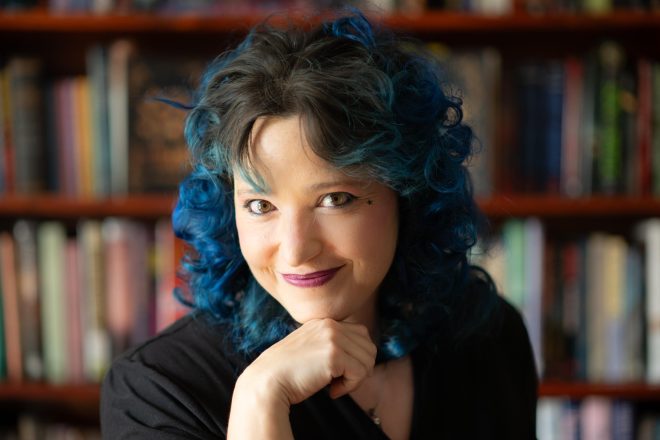
Alethea Kontis is a New York Times bestselling and award-winning author, storm chaser, and voice actress. Her two most recent releases—the pirate queen odyssey THIEFTESS and the fairy tale collection LEGENDS OF ARILLAND—can be found at an indie bookstore near you. Born in Vermont, Alethea currently resides on the Space Coast of Florida where she listens to K-pop with her teddy bear, Charlie.
