

Escape Pod 1067: Negative Scholarship on the Fifth State of Being (Part 2 of 2)
Negative Scholarship on the Fifth State of Being (Part 2)
By A. W. Prihandita
(…Continued from Part 1)
Semau made her way to the pier feeling bloated and hollow all at once.
She carried a duffel bag of medical instruments she’d stolen from the office: a stethoscope to record breaths and heartbeats, a set of syringes to take various kinds of fluid samples. These were instruments she normally used to collect data for the INT-Health model to analyze. That night, she’d put them offline, hoping against hope that a few hours of disconnection wouldn’t be enough to alarm the Medical Board.
And just in case, she’d reviewed the protocol for malpractice suspicion. The Board would have to send an overseer to lead her investigation. The nearest headquarter of the Medical Board was a system over, which meant the overseer would take a week to arrive, if Semau was ever suspected of anything. Which hopefully she never would be.
She had thought it would be difficult to spot Txyzna’s transparent body at night. It was, but at the same time, it wasn’t. He seemed to absorb moonlight such that the edges of his body gleamed silver, and the rest of it bathed in a pale sheen that looked like a moon’s reflection on water.
“Walk with me,” Semau said without breaking her stride, before Txyzna could say anything.
She had chosen Float 30 because it was the least populated island on this end of Nusa’s sprawling archipelago. There were more sheep and chickens here than humans or other sapient beings, which made Semau hopeful that whatever surveillance followed a practitioner-doctor, it wouldn’t follow her here. She’d turned off her communications, and no one but Txyzna seemed to be following her.
They walked away from the pier, then up a little cliff overlooking the ocean. It was only when they were safely hidden in a grove of pine trees did Semau stop. She sat on a fallen log, facing the sea and horizon.
“I’ve decided to help you,” she told Txyzna. “You might not want that, because what I’m doing is illegal.”
Txyzna came to stand beside her, a bulbous statue of liquid moonlight. “Thank you, Doctor.”
Semau hesitated. “Maybe you shouldn’t call me doctor outside my office. Semau is fine.”
“Thank you, Semau.” The waves of his face flowed into gentle curves that looked like a hundred little smiles.
“I brought some tools.” Semau reached for her bag. “I thought I could take samples and figure out how to analyze them later. And I can listen to your body with the stethoscope. Maybe I’ll hear the hole that way.”
She felt stupid. To be frank, she didn’t know what she was doing. Her job was only to collect the data the model needed; she was never taught how to make sense of all that.
“The data might not be enough to give you a prescription right away,” she added weakly, “but maybe they’d remind me of other illnesses I’ve seen. I’ll try and find a course of treatment that way, through comparisons.”
“Semau, I have been wondering. Doctors . . . human doctors . . . what is it that you do?”
Semau raised an eyebrow. “We deal with illnesses, of course.”
“And do you think my hole is an illness?”
“Is it not? If it’s not an illness, why would you seek a doctor?”
“I went because the field notes told me to seek a doctor. But I’m no longer sure that illness is the right word to describe what I’m experiencing. It is . . . the hole is . . . something different. A change, an anomaly.” He paused. “My translation machine is helping me understand what ‘illness’ is, in your language. It seems it is also a change and anomaly, but I am unsure if it is the same way that my hole is.” He paused again. “Semau, tell me, what is a ‘hole’ to you?”
For a long heartbeat, Semau did nothing except to stare at the plyzmorynox. She’d had alien patients before—that was the whole point of the Interspecies Health Model—and while she’d experienced miscommunication problems with some patients, it was never so fundamentally wrong. Never anything their interpreting machines and the health model couldn’t solve iteratively.
But then again, the health model already failed the plyzmorynox, an alien species more alien than others. She’d heard the faltering of Txyzna’s interpreting machine, the static noises it blurted out mid-sentences, but she never considered the possibility it was failing him just as much as INT-HealthGTT was.
With her heart beating in her throat, Semau looked away and did what was usually taboo in face-to-face communications: She pulled up the virtual interface of her translation implant and asked it to approximate the confidence level of the plyzmorynox’s translation.
It returned the number 23%.
“No,” she whispered.
“Semau?” Txyzna called out. His interpreting machine rendered his voice in a hesitant tone. It hovered above him, looking like an enemy warship. “What is a ‘hole’ to you?” he repeated.
Hands trembling, Semau picked up a fallen branch and used it to dig a hole in the ground. “This is a hole,” she explained. “It’s a void left when something’s no longer there. It’s nothingness.”
Txyzna bent his head over it, considered it with his eyeless face. He reached down and stuck a finger in the hole. “Is there something in this”—his interpreting machine faltered—“hole that you can feel?”
“What do you mean?”
“If you stick a finger in it, can you feel something?”
“I’ll feel the soil at the bottom.”
“But nothing else?”
“No. That’s why it’s a hole. It’s negative space.”
Txyzna fell silent. “Semau, I don’t think what I have is a hole.”
Blazing white heat lanced up Semau’s chest. She took a deep breath and tamped down her anger. Whatever communication problem happening here was not Txyzna’s personal fault, she must remember that. “What do you have, then? Please describe it.”
“That was why I sought you. I am unsure of how to describe it. A doctor was supposed to help me. My”—the interpreting machine halted—“grandparent was my parent’s”—a pause—“doctor. He helped my parent with his hole, helped him come up with his”—another pause—“song. The song describing his hole.”
“A song? You went to a doctor because you need help writing a song?”
“The field notes used the word ‘doctor’,” Txyzna said apologetically. “And I have no one else to tell me otherwise. With the way the field notes discussed it, I thought this was common practice in your profession, and among your people. Please, Semau. I am sorry for the confusion this has caused. I would have come to another one of my kind, if only I could find them.”
Semau gritted her teeth and rubbed her forehead with the heels of her palm. She’d come this far, broke laws for the first time in her life, because she’d wanted to help this lonely alien. The help he needed from her no longer seemed like the help she was prepared to give, but she already made it here. The least she could do was listen.
“All right,” she said. “It’s clear now that although we both use the words ‘doctor’ and ‘hole,’ we aren’t referring to the same thing at all. Can you try and describe what exactly you mean by these two terms?”
It took them an hour and countless machine-assisted stammering, but Semau finally got a serviceable picture of what was going on. A ‘doctor’ was a spiritual elder, though after the genocide the role had to be taken up by any surviving older relative. The ‘doctor’ helped young adult plyzmorynox wrap their head around the transformation happening in their bodies as they crossed the threshold between childhood and adulthood. This transformation centered around the ‘hole,’ which was some sort of change or anomaly that grew in their bodies, which apparently was hard to describe for the individuals possessing the hole, and downright insensible to anyone else.
In his sixth attempt to explain what the hole was, Txyzna offered, “Maybe it would be helpful for you to hear the name of the hole in another language. The umunua called the ‘hole’ ‘aoxono.’”
Semau’s translation implant announced in her ears, “The fifth state.” It also offered a box of contextual information through its virtual display:
The fifth state (Umunuan: aoxono)is a state of matter that forms the existential and physical heart of plyzmorynox-matori. It is a state of matter unique to each individual plyzmorynox, its properties only sensible and observable to the individual possessing it. The term “fifth state” is a reference to the four classical states of matter: solid, liquid, gas, and plasma. The plyzmorynox’s heart is a state of matter that is none of these four states; each heart is its own unique state. The umunua’s attempt and subsequent failure to understand the plyzmorynox’s fifth state is commonly regarded as the cause of the Matori Genocide.
“‘Its properties only sensible and observable to the individual plyzmorynox’ . . . ” Semau mused out loud. “That’s why it’s called a ‘hole,’ isn’t it? To the individual plyzmorynox possessing the hole, it isn’t a hole at all, it’s a substance only they can sense. But to others—including Alycia Balakrishnan-Smith—it’s not anything they can see, touch, or sense. It’s a negative space to them. A ‘hole.’”
“Yes, that is a sensible explanation. I am sorry I did not think of this earlier.”
Semau couldn’t blame him—she also hadn’t considered mistranslation. Translation machines had grown so ubiquitous; people hardly paid them any mind. “So, you need me to help you describe your hole, your fifth state?”
“Yes. It is very important. My clan had a song that recites the description of our holes, going five generations back. These descriptions are the only way our hearts can be understandable to others. If I cannot describe my heart, no one will be able to hold it in their minds. No one will know me.” Txyzna paused. When he spoke again, his interpreting machine rendered it in a hoarse, cracking voice. “I do not want to be unknown.”
“But how could I help you describe the hole, if I can’t even sense it?”
“I was hoping you would know that, as a doctor. I was hoping the expansion pack would know.”
“Txyzna, I’m sorry, but I don’t know anything about any of this.” She realized her own voice sounded hoarse and cracking. “But I can be here with you as you try to describe your hole. And I’ll remember your song, when you have it. You won’t be unknown to me.”
It was past midnight when Semau got home. She put her communications back online and was immediately greeted by the ding of notifications.
One caught her attention. Her interface had flagged it bright red. DISCIPLINARY WARNING: THE MEDICAL BOARD OF ETHICS.
Her heart stopped cold. In a frantic glance, she gathered what was going on: the Medical Board had uncovered evidence of malpractice and was sending an overseer to investigate. She forced herself to take a deep breath and count to ten, then went over the letter again for its recounting of evidence.
What had flagged them, of all things, was how on her third meeting with Txzyna, before he even finished paying for the expansion pack, Semau had asked him questions about his symptoms. The INT-Health interface had recorded the conversation, just as it recorded all doctor-patient conversations for diagnostic purposes. But Semau hadn’t hit the DIAGNOSE button. This was of course because she knew doing so was pointless without the expansion pack, but the system suspected she’d done the questionings to feed her own diagnosis.
Stupid. What a stupid, despotic machine. How could it claim to be the authority of all knowledge, fail laughably at being that, yet punish her for trying to fill the hole it left?
She gave Mrs. Achterberg a call. The old lady picked up on the third ring. “Didn’t take them long, huh?” she said. “Well, lucky for you, I’ve tracked down my great-aunt—which wasn’t easy to do, mind you, the old girl wanted ‘quiet retirement,’ as she put it. Anyway, she gave recommendations for legal counsels on intellectual property, medical care, and knowledge autonomy. We’ll need to fundraise for that, but let’s worry about it later.”
“Thank you, Mrs. Achterberg. I owe you everything.”
“Nah. Just bring me another starplant, will you? I do like purple.”
Even with legal counsel, her chance of escaping the combined might of INT-Health Inc., the Medical Board of Ethics, and the Intergalactic Consortium of Medical Universities was vanishingly small. But Semau did her best to put her worry aside, for now.
Her next step was to fill out the paperwork to relinquish her health model license back to the district’s Health Office. It was the only way she could guarantee the district wouldn’t have to spend a ton of money to purchase a new license because she burnt hers in a malpractice lawsuit. The Health Office could appoint and onboard a new practitioner-doctor more quickly than her investigation and trials would take. Until then, the other practitioner-doctors on Nusa would have to pick up the slack, but at least it wouldn’t be a permanent loss of a license.
It did mean resigning her post as practitioner-doctor. It did mean shrugging off all the hours that Guru Godang had spent training her. But she was trying to do her best, and she had no other choice.
There was a lump in her throat when she signed her name at the end of the form.
The next few days started with Semau waking up sweaty and stiff in the early hours of the morning. Most of the time it was from a nightmare of her being chased by a faceless overseer, other times it was of Txyzna melting into a puddle, and once it involved a crab-like alien vaporizing him like he was a dewdrop in a solar storm. And still, after every nightmare, Semau dragged herself out of bed and went about the business of giving up the job she’d been training for her whole life.
The only thing making this worth it was the calls she had with Txyzna, done over a communication line as secure and private as she could ensure, where Txyzna talked through his laborious attempt to describe his heart. Often, his interpreting machine would pause for a long time, and Semau couldn’t tell if that was because he was trying to come up with words, or if the machine was failing to translate the words he’d found.
On the sixth day, the call was much shorter. “I think I’m ready,” Txyzna said. “Would you come to where I am staying? I will share my song with you, if you’d still hear it.”
That morning, Semau stared into the mirror and found traces of tears in her eyes. When she opened her mouth to brush her teeth, she thought she’d glimpse her heart beating in her throat, behind her tongue, noisy and very real. She closed her eyes and imagined what Txyzna’s heart would sound like, but she could only hear hers. For now, she could only hear hers.
The ferry ride felt like walking on water.
“Good morning,” Txyzna said when he opened his door. White tiles covered the walls of the apartment, and the floor was non-slip vinyl. A square pool with clear blue water dominated the room, in a manner that made it obvious this was the primary living space of the resident being. To the side, though, a table stood surrounded by three chairs of various sizes. It was to this group of chairs that Txyzna led Semau. “Please, sit down,” he said, and she remembered their first meeting where it had been she who’d asked him to sit down.
Then he gazed at her, and by “gazed” it didn’t mean to stare with a pair of eyes, for he had no eyes; by “gazed” it meant he turned the compass of his attention onto her, steered the waves of his face so they ebbed and flowed in a way that made her feel embraced entirely, buoyant in a gentle ocean she could hold in her hands.
She was reminded that she was here to hold. The hole, the fifth state, was something she could never even touch, but she was here to hold it, nonetheless.
Txyzna began to sing. It sounded nothing like a song. It was a recitation, at best, a string of words announced through the fine mesh of his interpreting machine.
He sang of a hole that felt heavy, heavy as storm clouds pregnant with rain, heavy as the grains of salt carried by a drop of ocean water. He wondered out loud how many raindrops he carried in his heart, how many grains of salt; and decided it was just as many raindrops needed to nurture a cactus for three days, and for the salt, just enough sprinkle for a human to say, “This is satisfactory seasoning.”
Semau’s lips curved up. “This is satisfactory seasoning,” she echoed with an incline of her head, a compliment.
He spoke little of temperature, for he’d observed that his heart was neutral at best. It was neither winter nor summer, neither blizzard nor drought; it was the temperature of atoms that sat and vibrated all on their own—which was to say, no temperature at all. But he assured her this didn’t mean he couldn’t feel warmth or coldness. On the contrary, the neutrality of his heart allowed every drop of his body to hold as much heat as desired, or as little as needed.
It was when he attempted to describe the texture of his heart that his interpreting machine started to falter. “My heart feels like—in the middle of—that is—are floating—but never—like—”
After a few breaths of this, Txyzna fell silent. “I’m sorry. When I composed the song, I wasn’t doing it alongside my machine.”
“That’s all right.”
“I examined all the songs that were passed down to me. There were many words in them that I did not recognize, that I never heard my parent use. Perhaps in trying to describe something indescribable, my ancestors had to invent many new words. Since now there is no way for me to learn their meanings, I decided to take whichever words tasted right to me, even though I did not understand them. But I suppose for you, they are even more impossible to understand.”
A part of her had known this wouldn’t be easy; she was no longer a stranger to the betrayals of the interpreting machine. But still, dread scratched at her cavities. “But you need me to understand you,” she said. How could I do so, if I don’t understand your words?
It took Txyzna several human heartbeats to answer. “My father used to say that in our ancestral homelands, we did not speak with sound, and we certainly did not speak with words. Our homelands were ocean planets much like Nusa, and we spent most of our days in the water; and when you are in the water the only vibrations you feel are those of the sea waves, and those were enough for us. We spoke in the language of sea waves. We did not listen; we vibrated, we attuned, we felt.
“My father used to say that in our ancestral homelands, when one of us was living through the forming of our hole, we would all swim together in our ocean, so together that our bodies blurred into one ocean within an ocean. We’d hold our new adult and their newly formed hole at our center, and as they sang their song in our ocean wave language, we’d vibrate along with them, ebb and flow with them. That was how we used to know each other, when we were still as vast as oceans.”
Semau’s eyes drifted to the center of the apartment, where the pool of blue water sat in quiet waiting. There wasn’t even enough of Txyzna to fill this artificial body of water that would never be mistaken as the ocean.
“I’m sorry you only have me and this little pool,” Semau said. “But could I still hold you the way your ancestors held your siblings? Would it help me know you?”
The waves of Txyzna’s face eddied in a tranquil rhythm, almost hypnotizing in its repetition. “Yes,” he said. “This we can try.”
He ambled to the pool, lowering himself at the edge of the water, like how a child would sit and dip their feet before plunging in. But Txyzna didn’t plunge in; he seemed to melt in. One moment he was his bulbous self; the next, a cascade of mercury slipping into blue water.
His interpreting machine remained in the air, and it said, “Come in, Semau. And when you’re here, you can breathe as usual. I will give you the air you need.”
Semau peered into the pool and found she could tell where Txyzna was, because even though he was now as liquid as the water, he also glowed faintly silver. His mass spread over the blue of the pool, like a loosely humanoid puddle of mercury suspended in liquid sky. Semau took off her shoes, trying not to think she was about to step on the body of a friend.
She dove in and wasn’t sure what to do, but the silver puddle that was Txyzna parted to welcome her, circling around her. A part of her wanted to recoil as his mass inched closer to engulf her, but when the contact happened, it really didn’t feel alien at all. It felt just like soaking in warm water that faintly pulsed like the blood in her veins.
A bubble of air formed where her nose was, and she took a tentative breath. She found she didn’t choke, nor was she drowning. Txyzna held her tenderly, and as he’d promised, he gave her the air she needed to breathe. He was all around her now; she was floating in a cocoon of silver. She spun gently in it, and wondered if this was how a newborn plyzmorynox was buoyed to sleep, in the embrace of a physical lullaby.
Then, the singing started. She could feel it in her bones, like sea waves indeed, only that her marrow was as much the sea as the body of water engulfing her. She felt the vibrations on her skin and within her, gentle at times but a roaring crescendo at other times, a tickle and a punch, a whisper and a scream, a dance that swirled like streamers in the wind and twirled like the moon in its revolution chasing its own shadow. She inscribed in her mind and body every touch of the waves around her and within her, every vibration both atom-soft and earthquake-loud.
And in the middle of all that, as she spun in the buoy of her silver cocoon, she felt an emptiness, a negative space brushing against her arm. She recoiled in surprise. The cocoon that was Txyzna pulsed in reassurance, spinning her gently until she faced where she thought the hole was.
She reached out, a probe into deep space. The tips of her fingers touched the surface of her friend’s heart. She knew it was her friend’s heart because she couldn’t sense it.
But it needed no sensing. It needed no knowing.
She twisted until she curled around the hole that was a heart, holding it with her whole body. She closed her eyes and let Txyzna’s song wash over her, all as her fingers traced the boundary of his negative space. It seared her, the contrast between the nothingness of the hole and the vivacity of the song’s vibration. She was the fine line between absence and presence, between oblivion and omniscience.
When the song ended, when every vibration had been recorded in the marrow of her bones, Semau floated in a quiet so thick she could touch it. Txyzna pulsed around her, warm like the embrace of a womb, and she felt like she was born anew.
“Thank you,” she said, even though she wasn’t sure Txyzna could hear her. Thank you, and I hope this was enough.
When she was back on solid ground dripping water on the apartment floor, she stared at Txyzna’s bulbous body and felt the urgent need to hold him. This was the person who had a heart like storm clouds and salt, who spoke in a symphony of ocean waves. This was the person she got to know only because he was so unknown by the universe. This was the person she got to know despite not being able to know him entirely.
Txyzna opened his arms wide, his face rippling into tiny curves that looked like a thousand smiles. Semau fell into his embrace, and there she spent many minutes sobbing, her breath trembling to the echoes of his heart-song.
Later on, she asked him, “Do plyzmorynox cry, Txyzna?”
Txyzna answered, “Each of our bodies is one giant teardrop, Semau, my friend. But I appreciate the little ones you shed.”
It surprised her how little effort it took to understand Txyzna, once she accepted she didn’t need to understand him, only to hold space for him. With his heart-song still echoing in her bones, she thought back to her health model and the expansion pack, and how impossible it was to encode within them what she’d experienced with her own body.
And so, when the message came on her ferry ride back from Txyzna’s apartment, Semau faced it with the calmness she’d learned just a few moments before, from a state of being that wasn’t hers to perceive.
The message read: MEDICAL BOARD OF ETHICS DISCIPLINARY CASE #891283: OVERSEER ASSIGNMENT. Overseer name: Prenter Gozchanky. Charge: Pr. Dr. Semau Keo. Case update: Overseer arrived at charge’s home planet. Charge is advised to remain at known address for detainment.
On the heels of that notice came another message, this time from Mrs. Achterberg: Legal counsels secured. Also, I’ve launched a fundraising campaign, quadrant-wide. My great-aunt’s in on it too. One last ride, she said. We’ll be along with you. Stay steadfast, dear.
Semau nodded, even though she knew Mrs. Achterberg couldn’t see her. She’d give her a call soon, but first, she had one last thing to sort out. A letter to her bank, then another one:
Dear Txyzna,
I can’t give you back the money you spent on the expansion pack—they don’t give refunds. But my mentor, who also raised me, left a bit of money for me when he died. It’s the least I can give you.
I hope you can use it to maybe go and find other remaining plyzmorynox. They’ll need a doctor too. Maybe you can be that. You’ll be a better one than me.
It was an honor to know you. I’ll remember your song forever.
Your friend,
Semau
She sent the letter, took a deep breath, and turned her gaze to the sky. Seagulls circled above, calling one after another in a language she couldn’t understand. Under her feet, the sea was an undulation carrying her home—only that with the overseer waiting for her, home also meant somewhere she’d never been before, a fate undecided.
She didn’t know—not yet—if there were any remnants of the Negative Scholars after the execution of their leaders. But even if there were none of them left, she was willing to shoulder the burden of being the first in a new generation of them, to find out how to know—or not know—outside the paths and boundaries set by powers beyond her reach. She wasn’t sure if she was smart enough to do all that, but she would nonetheless try. If she could live the rest of her life stopping people from paying one million and eight hundred solars for nothing more than the trace of silence, then it would be a fine life indeed.
Guru Godang, this is your legacy, she thought.
This, and a song about how to hold, so very tenderly, that which you could not understand.
Host Commentary
By Mur Lafferty
And that was part 2 on Negative Scholarship on the Fifth State of Being by A. W. Prihandita.
THIS story gives me those awkward feelings of, “this is where trusting entirely in AI can get us.” Take the following theory:
1- The AI knows all.
2- The AI provides the data needed to help someone, for a price.
3- No refunds. If it doesn’t work, it’s clearly the problem of the doctor, because see #1.
I’m sure most people can think of a time a health care professional treated them like a set of symptoms, refusing to believe anything specific you might tell them that doesn’t fit their already settled assumptions. I hope you can also think of someone who listened to you and thought about your situation and how it could lead to the problems you have, and helped you on the way to good treatment. Unfortunately those people are becoming less and less available. Capitalism! Hurray!
This story also reminded me of something Ken Liu said to me several years ago, a thought that RF Kuang also used in her book Babel: that translation is a form of violence enacted on the original language. It forces the words into different shapes to be accepted by different people than it was initially intended for. Think about the translations of the Bible and Homer’s epics, where different people have taken nouns describing women and decided they meant “virgin” or “unmarried woman” “young woman” or “slut.” Most translations, as this story showed very clearly, are not a clear 1 to 1 word exchange. This is why a good translator is treasured and often included in award considerations alongside the author.
While the story was mostly about a doctor getting in way over her head (literally) and likely losing her license, we loved the feeling of hope at the end. Finally understanding why her mentor did what he did with the negative scholars gives the ending of this story a clear path to the beginning of a new story.
Escape Pod is 100% audience supported, and we count on your donations to keep the lights on and the servers humming. Head to https://escapeartists.net/support-ea/ to see all the available donation and subscription options, including Patreon, PayPal, Ko-Fi, and Twitch.
You can also support Escape Pod for free by rating or reviewing us on Spotify, Apple Podcasts, or your favorite app.
Escape Pod is distributed on a Creative Commons Attribution-NonCommercial-NoDerivatives license. Our music is by permission of Daikaiju. You can hear more from them at daikaiju.org.
That was our show for this week. Our quote comes from Voltaire: “Woe to the makers of literal translations, who by rendering every word weaken the meaning! It is indeed by so doing that we can say the letter kills and the spirit gives life.”
About the Author
A. W. Prihandita
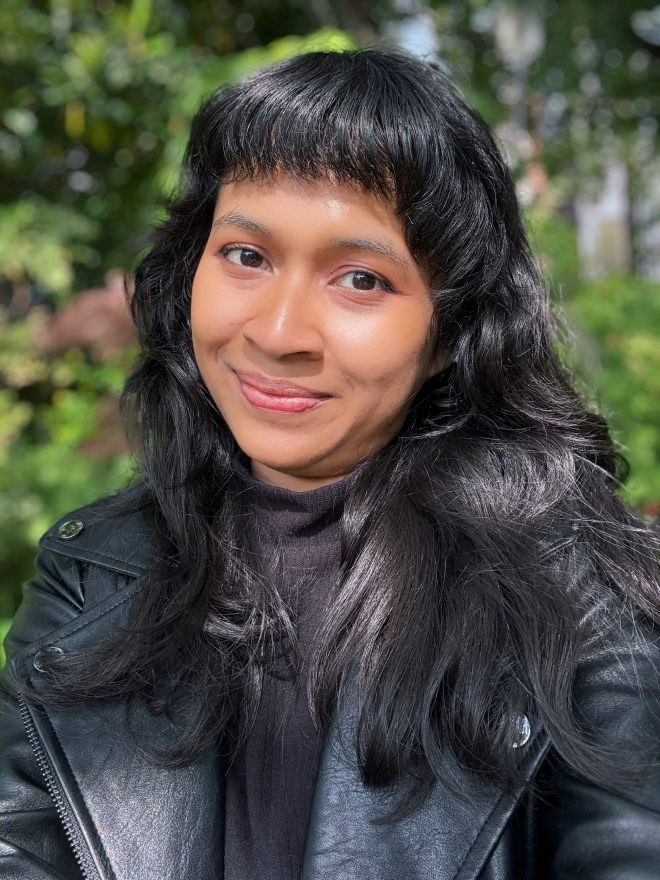
A. W. Prihandita (she/her) is a Nebula Award-winning author of speculative fiction. She splits her time between the U.S., where she pursued her graduate studies, and Indonesia, where she grew up and where her home remains. She attended the Odyssey workshop in 2023 on their Fresh Voices Scholarship, and the Clarion workshop in 2024 on their Octavia Butler Scholarship. Her stories have appeared in Clarkesworld, Uncanny, Cast of Wonders, The Dark, and khōréō, among others. Besides the Nebula Award win, her story has also been a finalist in the Ignyte and Eugie Awards. After earning a Ph.D. in language and rhetoric from the University of Washington, she is currently pursuing an MFA in Creative Writing (Fiction) at the University of Maryland, College Park.
About the Narrator
Tatiana Grey

Tatiana Grey is a critically acclaimed actress of stage, screen, and the audio booth. She has been nominated for dozens of fancy awards but hasn’t won a single damned thing. She lives in a minuscule apartment in Brooklyn, New York which she hopes to move out of one day because they don’t allow pets. What a travesty. Magic the Gathering fans, hear her bring familiar faces to life on “Lorwyn, Eclipsed” out now on Magic The Gathering’s Magic Story Podcast, wherever you listen to podcasts
