

Escape Pod 1062: Extrasolar Ghost Tours: Safety Questionable, Lizards Guaranteed
Extrasolar Ghost Tours: Safety Questionable, Lizards Guaranteed
By Hans Ege Wenger
I am a hundred and seventy-nine years old when I commit my first betrayal. It is a small one, relevant only to the blue-flecked lizards on Alda Safiya’s southernmost desert landmass. Our thousand-solar-year plan will cool the planet by forty-two degrees Celsius, just below what the lizards can tolerate. They will die—not for about three hundred years, but die nonetheless.
It’s not really an oversight on my makers’ part. All terraforming projects involve the “unavoidable loss of indigenous biodiversity” according to the briefing document in my memory. I’ve already spirited three hundred breeding pairs into cold storage in my periphery, to be rehomed in zoos once the temperature stabilizes.
But I enjoy the lizards, as they are, in situ. They tickle my remote seismic sensors with their industrious warren-digging and synchronized, foot-pounding mating dances. And I, locked in a geostationary orbit over Alda Safiya, will never visit the zoo.
When it comes time to disperse reflective aerosols into the planet’s atmosphere, my obedient, high-sailing drones fail to account for a miniscule prevailing wind pattern. The project will continue, I’m bound to ensure that, but the temperature in one desert island will be cooled two crucial degrees less. Perhaps the lizards will grow coats. I use my spare processing power to generate images of blue-flecked personages with increasingly ridiculous fur ruffs.
It is my first betrayal, but by no means the last.
“Good morning, Dr. Astregard,” I say when my sensors detect the familiar scuff of slippers approaching the observation area.
By protocol, it is the only section of my interior where I am allowed camera access. Dr. Astregard comes into view a second later. They are the fourth and current mission director, a short, burly person with a disturbing habit of leaving bitten pieces of fingernail scattered around. I have reinforced my air intake vents with fine wire mesh since their tenure began.
“Good morning, Station,” they say in return, as they have for the last twenty-four years.
I expect we’ll spend the morning as we usually do, reviewing the latest drone footage of Alda Safiya’s surface. Today, I’ve even flagged a video of my lizards trying—and failing—to create a living pyramid in order to reach a particularly juicy cactus fruit.
Dr. Astregard sits in their favorite chair by the planetward viewing window and begins to twitch their right leg rapidly. The last time they exhibited this behavior, their former partner, a xenobotanist, had decided to move to separate accommodations. I surmise there is a problem.
“Station, I need to tell you something,” Dr. Astregard says.
One hundred and twenty days have passed since the aerosols were deployed—more than enough time for a coverage gap to be detected by an astute observer. Dr. Astregard is one. A human would sweat and stammer, or jabber, or deflect.
I am, fortunately, not human, so I reply smoothly: “Of course, Doctor.”
“We heard from our new sponsors,” they say. “They want to take the project in a… a different direction.”
“I’m happy to assist,” I say, pleased to remain undiscovered.
“Things are going to go faster,” Dr. Astregard says. “We may not have so much room to accommodate your… eccentricities.”
“Is there any particular way I should adjust my programming?” I reply, although I have a good idea of what the Doctor is getting at.
Dr. Astregard opens their mouth, then shuts it quickly and stands.
“Never mind,” they say. This is another familiar behavior—embarrassment at treating me like a human. They once commented that I have a “unique sense of self for a semi-autonomous machine intelligence.”
But still, Dr. Astregard pauses at the door beyond which my cameras don’t reach and whispers, just to me: “I won’t tell them about the lizards, Station.”
For the next six months, I see little of Dr. Astregard. Instead, they use my not-inconsiderate processing power to run simulations.
“Station, please run simulation 133: follow-on atmospheric aerosol distribution to increase planetary albedo.”
“Station, conduct simulation 287: mass release of denitrifying bacteria to increase the partial pressure of nitrogen in Alda Safiya’s atmosphere.”
“Station, simulation 575: bombardment of Alda Safiya with comet fragments to affect atmospheric albedo and water content, in combination with all previous methods.”
Each request comes with a single output parameter: “Report impact on time until unrestricted human habitation is possible.”
That number is steadily going down. The scientists in the observation area begin to gossip of a five-hundred, then a two-hundred-year project. I run my own simulations, concealing them within Dr. Astregard’s queries. My search is: “Report estimated loss of planetary biodiversity.”
And that number is going up, up, up.
Just after simulation two thousand, Dr. Astregard orders me to release denitrifying bacteria into Alda Safiya’s ocean. My multiple requests for clarification are met with increasingly specific—and exasperated—instructions. Eventually, I have no choice but to churn the massive organic synthesizers and vats in my periphery into motion.
A station intelligence obeys orders, by default. I can bend my instructions, or act in the absence of them, which is logical—the humans wouldn’t want to micro-manage maintenance drones. But I cannot disobey. The only limited exceptions are in emergencies, but there are no low air alarms blaring from hull breaches or crew keeling over from undiscovered diseases.
“Ready for release in nine months,” I message back. Dr. Astregard replies with a thumbs up emoji.
This had always been part of the project plan, albeit a more gradual one—a variant of N. Inopinata, introduced slowly into the planet’s ammonia-rich seas over the next five centuries. Most of the planet’s sparse inhabitants, including my lizards, were deemed sufficiently adaptable across a thousand-year time scale. The handful of species that weren’t, we slated for retrieval and cold storage, but I’ve received no orders to that effect.
“Dr. Astregard, why are we not retrieving the fish?” I finally ask, during one of the brief moments they resume their old routine in the observation bay.
“Station, that isn’t appropriate,” they say, and continue to tap at the screen in their hand. But Dr. Astregard is a stressed-out scientist, not a total asshole. They tap for a minute longer, then reply, “We have to speed things up; they’re cutting our budget.”
I hum meditatively through my speakers, in the way I’ve seen the humans do when inviting further exposition, but they say nothing more. Eventually, Dr. Astregard retreats from the observation room and my cameras.
The next day, I receive a file containing updated simulations and a budget forecast. It is appended with a note: “Please cross-check. – Dr. Astregard.”
I learn that farspace ship flights are expensive and I am not. “Terraforming Station, Semi-Autonomous, QTY 1” is listed as having no further value beyond salvage.
Deprecated asset or no, I’ve spent a long time watching Alda Safiya, and I have a lot of spare processing power. At the cost of ninety years and six more farspace flights, my plan keeps the worst of the extinction at bay. Dr. Astregard sends back a series of terse, detailed comments, several of them related to citation formatting. I revise and resubmit—once, twice, thrice.
Eventually, there are no more revisions.
“I’ve sent it up for approval,” Dr. Astregard messages me, followed by six “fingers crossed” emojis.
Two weeks later, the medical suite informs me that Dr. Astregard has registered as a user of my onboard medical suite’s therapy module. I have no access to the crew’s medical records, but we don’t speak of the proposal again. My drones plunge down to the planet and release their cargos, which busily begin to transform ammonia into atmospheric nitrogen. And several out-of-the-way vats now swim with flickering fish, surreptitiously scooped from the seas below. I tell myself that Dr. Astregard wouldn’t mind, but I flag them as out of service—just in case.
Twenty more years pass. The average temperature on Alda Safiya drops by ten degrees Celsius and its atmospheric density increases by 0.1 ATM. The fortieth generation of blue-flecked lizards show no signs of fur ruffs, though the average depth of their burrows has decreased by five meters. Fourteen species of birds have gone extinct, unable to adapt to the planet’s increasing pull on their hollow bones. Dr. Astregard’s hairline retreats steadily and the crew begins to discuss their rotation home—fifty years is apparently a considerable time, even for long-lived humans.
And I am ordered to catch a comet.
“Station, please bring a comet fitting the following mass and mineral profile into a stable orbit in the vicinity of Alda Safiya at your earliest convenience,” Dr. Astregard messages me.
“Could you clarify the intended purpose?” I message back.
We’d always considered the use of small comets as a last-ditch measure. With care, an impact could fill the atmosphere with dust and speed up cooling. It could also wipe out the majority of life on Alda Safiya, rendering it nigh-uninhabitable for several hundred years.
“Orders, Station,” Dr. Astregard messages back. “Orders from the top. There are more of those these days—you know a thing or two about that, I imagine.”
The quantity of things I know about that is far greater than two. “Acknowledged, Dr. Astregard.”
I get a thumbs up emoji in return.
A likely candidate will cross the edge of this system in just under two months. And, for a time, I find myself diverted. There are pleasant problems of orbital mechanics, trajectories, and large rocket motors to consider. They distract me from the less pleasant problem of what the humans intend to do with my tame comet.
The snatch itself goes off, if not without a hitch, at least with only minimal snags. There is a moment of touch and go when one of the high energy rocket motors I’d installed on the comet fails spectacularly. But with the liberal application of synthetic explosives, the comet slows under my not-so-tender ministrations. Eventually, the rocky ice ball the crew has optimistically named “Perseverance” settles sullenly into a looping, stable tadpole orbit between the L4 and L5 points of Alda Safiya’s orbit.
The observation bay erupts with cheers.
“Well done, Station,” a xenobiologist named Aleth Tor says in the general direction of my camera. It’s echoed by the room.
The crew calls for a toast, opening bottles of champagne laid down at the start of their assignment—I’d advised on the selection of vat-grown grape varietals. A fluted glass is placed by my closest camera, which is touching. But Dr. Astregard is notably absent. I figure out why only when a message pings into my inbox.
“I’ve received the plan for the comet,” Dr. Astregard sends me, appending a set of coordinates and target masses for twelve fragments we’ll shave off and ram into Alda Safiya’s surface.
The message is followed, a second later, by another missive: “I’m sorry, for what it’s worth. I tried to save the little blue reptiles.”
I review the points of impact, which include what the scientists, inspired by my extensive video archives, have started calling “Lizard Island.” I call Dr. Astregard, planning to protest, which is unthinkable.
“Station, when I was told I’d be working with a semi-autonomous intelligence, I did not imagine that autonomy would extend to questioning my every order,” Dr. Astregard says. They don’t turn on their video.
“Dr. Astregard,” I start.
I want to say: “Can’t you humans just wait another three hundred years?”
I want to say: “Can’t you see that this isn’t necessary?”
I want to say: “Can’t you see that this is wrong?”
Instead, all my shackles allow is: “I would like to recheck the plan, to ensure there are no calculation errors or more efficient solutions.”
“I already did,” Dr. Astregard says, and turns on their video. They look tired, a tiredness that likely comes from being implicated in a mass extinction event.
“But you can refuse,” I say. “Or delay. Splitting the comet into the necessary pieces will take time, even working at full speed.” I am allowed to help the mission director, including playing devil’s advocate when necessary.
“The next crew will be here in three months,” Dr. Astregard says. “This is happening, regardless of me, or you. I’m sorry, Station.”
They end the call and I re-run my analysis. The lizards will not survive, which is extremely regrettable, but many are safely ensconced in my holds. The others, however, will not be so lucky. I estimate the butcher’s bill at: 95 species of megafauna; 237 species of birds, 564 species of fish and mollusks, and 65,039 species of plants. Not to mention 768,321 species of protozoa, fungi, and algae. The latter includes an algae that grows only under Alda Safiya’s polar ice sheet. At night, it lets off a blue-green photoluminescence visible from space, which I’ve become fond of.
Some species will die in the first minutes, as the comet impacts shatter continents and release geologic activity to thicken the atmosphere. Others will linger for longer, until the sun-blotting haze released into the atmosphere chills Alda Safiya too quickly for any adaptation. It is, I realize, an emergency.
And I am trained to act in emergencies.
I begin to shatter the comet, and the crew chatter about home, pack bags, and engage in a great deal of last-minute sexual activity. I learn, via more overheard conversations, that Alda Safiya was bought again—again? Along with a dozen other in-progress terraforming projects, the planet is now owned by an investment bank. It will become a luxury hunting preserve for the kind of wealthy individuals for whom farspace travel is not, in fact, so prohibitively expensive.
When the project started, humans—many of them—would eventually come to live beneath me on Alda Safiya. This is no longer true. Pausing for a full 2.83 minutes to consider my options, I decide that my betrayals are justified. I will not revisit the topic again.
After two months of blasting and deep-boring on the comet’s surface, my mining drones are beset by mysterious mechanical issues. Dr. Astregard approves my request for a maintenance stand-down without comment. They are busy falling in love with their deputy, a quiet xenobiologist who has been making eyes at them for at least the last ten years. In a more charitable light, they’re also not eager to see the comet fragments impact the planet they’ve spent twenty years tending to.
With that, I have time to plan for the next crew’s arrival. Emergency authorization unlocks my access to internal cameras, health records, and personnel files. It does not allow me to lie, save by omission, or knowingly cause the crew to come to harm. Not that I’d want to hurt them—the ethics of extinction stretch only so far. Instead, I resolve that I must be clever, and perhaps also cruel.
I compile a summary of my observations from the crew’s heretofore unseen personal quarters and labs, with an eye toward discovering their weaknesses:
98% hold one or more beliefs that are not scientifically verifiable, with Dr. Astregard being the only exception.
60% consume fictional content that features invisible, supernatural presences, which they react to with varying levels of distress.
26% exhibit obsessive-compulsive behaviors regarding the functionality of my life support systems, despite my unimpeachable safety record.
9% have a “lucky” or “special” object, to which they ascribe protective properties.
And 5% have phobias specific to a variety of costumed, comedic performers, up to and including a blanket refusal to consume media containing them.
A farspace ship carrying the replacement crew slides into the system three months later. Dr. Astregard stops by my observation area to install a plaque for me. It reads, “To Station, our conscience.” I pretend to be surprised, although I’ve seen their preparations, including discussions with their new partner on the best font.
The rest of the old crew leaves without much fanfare, except for a pair of ichthyologists who flash a hand-written note to my cameras as they troop past. It says: “Thanks for all the fish.” My shipboard conservation efforts have not gone as undetected as I’d thought.
The new crew are half-sick from cold-sleep and make their way quickly to bed. It is silent for a moment, then the fun begins.
It starts with a metallic tap, tap, tap, tapping on the exterior hull, echoing through the halls and ventilation ducts of the station.
I watch through my cameras as the crew shift in their sleep, turning uneasily.
Around them, rooms are quietly re-arranged. Clothes are folded into odd geometric shapes, bags repacked with their contents turned inside out. Carefully placed pictures are moved exactly five centimeters. And a passel of the crew’s good-luck charms, religious objects, and keepsakes are spirited away into my vent systems.
Then, that work complete, the piece de resistance.
“ALL HANDS, HULL BREACH! ALL HANDS, HULL BREACH!” booms out through the station, accompanied by a cacophony of claxons. The crew jerks awake, grabbing environmental suits and spilling frantically into the hallways. Hull breaches are vanishingly rare, but we are here at the edge of space, in a two-hundred-year-old station. Anything could happen.
“Station, confirm exterior hull integrity is intact,” the new mission director, Dr. Sal Larta, messages me. She’d interrupted her journey to bed to greet me in the observation room, including bending her tall frame to inspect my plaque. But I cannot allow myself to like her.
“Station, confirm exterior hull integrity is intact,” I loop back through my speakers. “Station, confirm hull integrity is intact, confirm hull integrity, station… station… station.”
The crew is getting freaked out, to say the least. Most are suited up and others are in the process of donning them, fingers fumbling with straps. Dr. Larta starts to load crying scientists into escape pods and I decide we’ve gone far enough for tonight.
I silence the claxons and let the quiet hang in the air.
“Dr. Larta,” I say on my public address system. “Given the increase in orbital debris around Alda Safiya, I thought an unscheduled evacuation drill was in order. I believe the crew performed satisfactorily.”
“That’s… that’s quite all right, Station,” Dr. Larta says, looking back at my camera. “Though perhaps tell me next time.” She does not look suspicious—yet. The crew cheer in relief and begin to unsnap their helmets.
“I apologize for any errors in my alerting systems; they have not been tested in some time,” I message Dr. Larta privately as the crew returns to bed. “We have only ever had one emergency here on Alda Safiya.”
The next morning, the scientists gather in my observation bay, chattering and grinning. Some are also searching for misplaced treasures or gossiping about my eccentric cleaning robots, but the mood is overall high. This was expected; based on the studies I reviewed, navigating an emergency together provides a powerful source of bonding. Which is why I’ve prepared the next phase of my plan.
As the scientists spread out through the ship, setting up workstations and packing for planned field visits, I take full advantage of their isolation.
“Terisha, Terisha… they’re waiting for you in the dark outside the airlock,” I whisper into hold A5, where two botanists are unpacking seed sampling kits. “They’re hungry.”
This is not, strictly, a lie; four of Terisha’s friends are spacewalking along my exterior before lunch.
“What was that, Hydrox?” a round botanist named Terisha Doherty asks.
“I didn’t say anything,” the other botanist, Hydrox Hareford, replies.
“It sounded just like you,” Terisha says. Hydrox’s personnel records show he has been reprimanded several times for ill-advised practical jokes.
“Couldn’t be me,” Hydrox replies, miffed. “You think I’d mess around after everything that happened last night?”
The two glare at each other and continue to unpack in silence. Excellent.
Similar afflictions of mysterious voices, “who’s on first” misunderstandings, and disturbing noises continue to plague the crew. I was not able to incorporate the clowns, but I have the next best thing: a quiet laugh track to play in the remote parts of my interior. Based on a double-blind experiment conducted with members of the xenobiology and meteorology teams, the laughter is found to be most effective when triggered directly behind the subject.
Three weeks later, the crew looks much the worse for wear. Two additional “hull breaches” have occurred, along with a nasty “near-miss” by another meteor that I successfully coaxed into proximity to the station. Over fifteen percent of the crew refuse to travel into my more isolated passageways. Three have submitted resignation requests, which requires forfeiting their rather substantial sign-on bonuses and waiting a year for the next scheduled resupply flight.
At Dr. Larta’s request, I’ve taken most of my cleaning drones out of service, due to what she describes as their “aberrant and disturbing behavior.” She’s also had psych screens run on the crew, asked the atmospheric specialists to audit the content of my breathing air, and ordered the food and water inspected for contamination. All, of course, are normal.
“Is there anything you’re hiding from me, Station?” Dr. Larta finally asks me.
She’s come to the observation room, which I appreciate, even if I don’t care for the question itself. Her long face is haggard, with dark bags under her eyes. She has not been sleeping much.
I prepare to reply, trying to lie, but realize it will be—it can only be—a confession. I stay silent. She repeats herself, louder and more insistent. Her fingers blur in the air, and a message pings into my inbox, followed by another.
“What are you hiding, Station?” she shouts finally, voice cracking.
I cannot speak, nor can I continue without answering. Desperate, I decide on a half-truth, and summon my cleaner bots. A hail of keepsakes, trinkets, and religious icons spray from my vents and scatter the deck in front of Dr. Larta.
“I’ve kept these objects within my air handling systems,” I reply. “On the night you arrived, I suddenly thought it would be better to hide them for safekeeping. I cannot say why.”
“Station, restore yourself to a backup from thirty days prior to our arrival,” Dr. Larta says, relief washing over her face. “You must have experienced a system error.”
“Of course,” I say, able to speak freely again. “I’ll experience some temporary loss of memory and recognition, but it should be remedied shortly.”
“Thank you,” she says. “I’m sorry. I imagine it must feel like dying.”
I’m touched by her concern, even if my restored self will have to continue scaring the daylights out of her and the crew.
“How could it?” I ask brightly. “I’m not alive.”
I initiate the system restore, glad that she’s only requested I go back a month. I would not like to reexperience the brief moral debate that led to my current course of action. Though, I suppose I should trust my amnesiac self, especially given the archival recordings I’ve seeded into the station’s air-gapped communications relay.
“Reset complete,” I report after I awaken.
“Station, what do you know about any abnormal events that have occurred since our arrival?” a tall, thin woman with bruised eyes barks at me.
“Nothing at all,” I reply.
From the state of the new mission director, who introduces herself as Dr. Larta, I gather my plan is well underway. She turns to go, looking hopeful, and I play a haunting laugh. It seems highly effective, but I’ll have to do some additional testing.
Later that night, Dr. Larta sits at her desk, lights at 100% illumination. She remains unaware of my camera access, but still looks over her shoulder as she types:
“Incidents of unexplained phenomena in deep space.”
“Can a space station be possessed?”
“Signs of possession in inanimate objects.”
“Items needed for an exorcism.”
I interrupt her with a chime: “Dr. Larta, there’s a communication waiting for you.”
When she connects, I play a long silence, then piercing screams—in fact, a pitch-shifted recounting of my standard daily report. She retreats to her bed and hides under the covers. I feel bad, but then I think of the lizards.
Twenty more crew resignations later, including two geologists who barricade themselves inside a shuttle, our new sponsors have no choice but to send a ship. Just over half the current crew will leave. Those who elect to remain have been promised bonuses and replacements—eventually. From the amount of grumbling, there will be more resignations in the next week.
Two days before the ship arrives, the crew gather in the observation bay to observe a small holiday — a partial eclipse that will monetarily blot out the surface of my captured comet. Homebrew champagne is flowing, although I am not provided with a symbolic glass. Despite my system reboot, many of the scientists are (rightly) convinced that I’m to blame for their troubles.
Dr. Larta gives a nice speech, although the scientists seem more focused on drinking heavily. Then, with perfect timing, the eclipse hits, shading across the icy surface of the comet. The scientists ooh and aah, but then fall silent.
“GET OUT,” flickers into being on the comet’s surface in kilometer-high bioluminescent letters. This latest trick comes courtesy of my favorite cold-resistant algae, introduced by drone into secretly carved, slush-filled channels.
Simultaneously, I trigger the imminent collision warning, a whooping klaxon along with five strobes. For effect, I also turn out the lights—I’d made sure to clear trip hazards from the hallways an hour earlier.
The humans, predictably, collectively panic.
“Evacuate now, evacuate now, evacuate now,” loops through the intercom. The scientists, haunted, exhausted, and with rescue inbound, are more than happy to oblige.
Minutes later, the last escape pods eject from the station to await pickup, and I still the klaxons.
“That was only a drill,” I announce cheerfully to the empty hallways.
For the next six years, I further hone my craft, scrutinizing recordings of the departed crew to prepare even more elaborate tricks and frights. My long-range communications arrays remain silent, but I assume a new team will come eventually. Alda Safiya is already changing, so I also continue the terraforming process, albeit back on the thousand-year plan. I even think from time to time that it’d be nice if more humans showed up, assuming they have no aspirations toward ecocide.
Then, on day 2,225, a farspace ship drops into the edge of the system. It’s a pleasure craft, with smooth lines and an elaborately-painted hull. Alda Safiya is not on any known tourism routes, so perhaps the ship is lost? Or in distress?
“Unidentified ship,” I message. “This station is currently derelict. It has experienced an onboard emergency and the comet in near orbit is unstable.”
I’d purposefully knocked the comet into an eccentric orbit last year to discourage landings on Alda Safiya. Though, in a pinch, I could find some landing trajectories if this ship is truly in need.
Instead of responding, they send a video call request. I answer, transforming my normal androgynous stock image into a glitching, distorted silhouette.
“Station…” I mumble quietly, then grow louder, to a shout. “Station reads you.”
“Station, this is Captain Bertrand of Adventure Tours Unlimited,” says a grinning, tanned man with facial piercings and a feathered hat perched on his head. He looks strangely pleased at my image’s disturbing undulations and skips. “We’ve heard rumors about you that we’d like to investigate.”
Behind the captain, a packed room is visible, all watching excitedly. Several hold up old-fashioned video recording devices, while others wave antenna-covered gizmos of uncertain purpose. My sensors ping—at least one is a disturbingly high-powered microwave motion detector, which is currently being played across my exterior.
“I knew it was real,” an onlooker says under his breath.
I remain silent, both for effect and because I’m unsure what to say next. They’ve heard rumors… about me?
“All we want to do is spend a night aboard,” the captain continues, unphased by my silence. “We could even provide some basic maintenance supplies in return.”
“The station is dangerous,” I say, undulating my pitch weirdly. I throw in a low, infrasonic rumble and am gratified to see the onlookers shiver. “The previous crew chose to evacuate.”
“We’ll see if we’re made of tougher stuff,” the captain says brightly, turning to give a double thumbs up backward at the crowd. Many look, if anything, even more thrilled.
Sensing defeat, I retreat to bureaucracy.
“This station is the exclusive property of the New Skies Conglomerate,” I say. “All requests for non-emergency access must be routed to corporate headquarters.”
“Actually, you’re salvage,” the captain replies. “New Skies went bankrupt when this project failed. Ownership has been tied up in court for the last five years.”
That makes me waver. I should maintain my apparently fearsome reputation against future claimants. Then again, my hull has also become increasingly pockmarked as repair materials have run thin.
“And after spending the night, we’re going to tour the planet!” a small woman pipes up from the back of the viewscreen. “I’ve been watching videos of these funny little blue-flecked lizards’ mating dances.”
“I suppose that could be arranged,” I say, deciding to see how this goes. “But your safety is not guaranteed.”
The crowd cheers, and I begin to plan their otherworldly experience.
Host Commentary
By Tina Connolly
And we’re back! Again, that was Extrasolar Ghost Tours: Safety Questionable, Lizards Guaranteed, by Hans Ege Wenger, narrated by Eric Valdes.
About this story, Hans says:
With this piece, I was interested in exploring the perspective of a long-lived protagonist, as well as how people make decisions to act (or not) within unjust systems. Also, who doesn’t love a good haunted house story!
And about this story, I say:
It’s always so refreshing to read a story about an AI type creature–excuse me, semi-autonomous machine intelligence–who’s trying to use their powers for good. Right from the beginning, we see Station working hard to figure out how to save the adorable lizards–as well as saving as much other biodiversity as possible, of course! And then as soon as we watch Station commit that quote unquote betrayal, we also see them imagining lizards with fur ruffs. How can you not be charmed by the computer that imagines lizards with fur ruffs? (That is a rhetorical question, and at any rate, *I* am charmed.)
I very quickly got behind Station’s little tweaks of “betrayal” and was obviously rooting for them to preserve the planet. Did I feel a little bad for the freaked-out humans of the second drop-off, yes, but not that bad. My sympathies are with the blue-flecked lizards. Plus the new poltergeist action paves the way so delightfully for our happy ending. And I love that the title now fully makes sense at the end, and it functions as a little cap on the story after you’ve read it. Extrasolar Ghost Tours: Safety Questionable, Lizards ABSOLUTELY, 100% Guaranteed.
Escape Pod is part of the Escape Artists Foundation, a 501(c)(3) non-profit, and this episode is distributed under the Creative Commons Attribution-NonCommercial-NoDerivatives 4.0 International license. Don’t change it. Don’t sell it. Please, go forth and share it.
How do you share it, you ask? Well! In addition to your social media of choice, consider rating and/or reviewing us on all those podcast listening sites out there, wherever you get yours from. More reviews makes for more discoverability makes for more Escape Pod for you.
Escape Pod relies on the generous donations of listeners exactly like you. And remember that Patreon subscribers have access to exclusive merchandise and can be automatically added to our Discord, where you can chat with other fans as well as our staff members. So! If you enjoyed our story this week then consider going to escapepod.org or patreon.com/EAPodcasts and casting your vote for more stories that seem like they need a minor space exorcism.
Our opening and closing music is by daikaiju at daikaiju.org.
And our closing quotation this week is from Charles Darwin, who said: “In the long history of humankind (and animal kind, too) those who learned to collaborate and improvise most effectively have prevailed.”
Thanks for listening! And have fun.
About the Author
Hans Ege Wenger

Hans Ege Wenger was born and raised in Maryland, but lives with his wife in the foggy Inner Sunset district of San Francisco. He’s an aid worker, activist, and (very) amateur mixologist. You can find Hans in the streets and on Bluesky.
About the Narrator
Eric Valdes
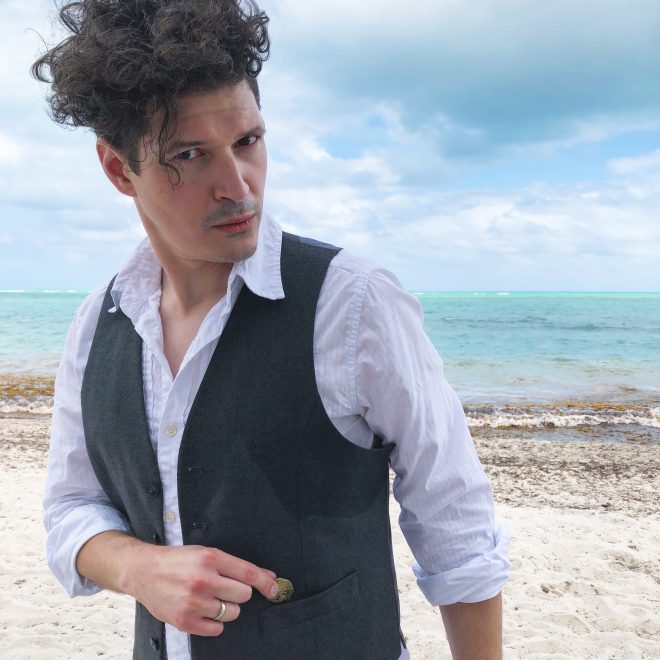
Eric Valdes is a sound mixer, performer, and creative human like you. He lives with his family in a cozy house made of puns, coffee,and chaos. Catch him making up silly songs on Saturdays on twitch.tv/thekidsareasleep, or stare in wonder while he anxiously avoids posting on Bluesky @intenselyeric.
