

Escape Pod 1059: A Little Freedom Makes Us Rebels
Show Notes
This episode is sponsored by Sleepphones! Use code ESCAPEPOD and get 10% off your purchase.
A Little Freedom Makes Us Rebels
by Kathleen Schaefer
When our ship made landing after three centuries in space, we were ready for the inhospitable lands, the harsh nights, and the hard labor of terraforming a new planet. Aboard a generation ship, labor is familiar: every moment requires our attention. But here, nothing prepared us for the idleness. These miniature pockets of time that don’t demand our productivity are more alien than the silt-eating rubberfish in the streams of our new home. We survived six generations in space, but if anything ends us, it will be this false bounty of unfilled minutes.
I spend these strange, unoccupied moments watching my little brother Luca race his friends along the dirt-dust plains of our new planet. The children skirt the fragile habitats of terraforming biofilm, knowing not to disturb its activity. The mosses and algae work diligently, turning this planet into something livable, quietly shaming my own lack of productivity.
I don’t even play. Just past my teenage years, I think myself too old to ever learn how. Instead, I vicariously enjoy the sports the children invent from nothing but dirt and imagination. Their elders had no history of games to pass down. My feet fidget, unaccustomed to standing still. I will never be used to this idleness, but foreign as it is, I find I like it.
Luca’s path leads the children underneath the shadow of the old ship that carried us here, back when he was still an embryo. The kids aren’t allowed inside the hulking beast of metal and glass—few of us venture within its caverns these days—but I’ve watched them dare each other to crawl up through the loose venting panels and unsealed doors. I am not credulous enough to believe Luca when he swears he’s never slipped through a pried-open hatch. That kid was born into a world with idleness, and idleness demands to be filled.
That ship is crafted from generations of painful memories that I inherited, nurtured, and grew. I will never shake free of them. That monolith of metal is a gravestone to the people we lost, and a monument to the harsh migration that finally brought us here. But the ship does not haunt the youngest among us. To Luca, its omnipresent backdrop in his life makes it a set piece for his games.
Luca trips over a rock, and every muscle along my back tenses. I take three breaths. My brother picks himself off the ground and claps the dust from his hands.
“Are you cut? Did you break the skin?” I call out.
He humors me only long enough to check for lesions, then keeps running. My brother does not accept that this ground was not made for him. The bulky terraforming machines we installed when we made landfall cannot scrub every pathogen out of the dirt. Each year, we lose one or two of us settlers to minor falls and cuts that don’t respond to Earth antibiotics. Mama worries her final child will be the next victim.
She doesn’t tell him this. Instead, she reprimands him for wasting the day with games. She calls him unindustrious and a disappointment. A new colony takes so much work to stay alive, and all that boy wants to do is build mud forts and chase the puckered alien fish darting through the streams.
I was industrious as a child, up to the day our ship made landing. Productivity was the only virtue children could claim, the only trait that would elicit praise from elders. I lived on praise. Most of us did. There wasn’t much else to assure us we were worth the oxygen we consumed.
I worked small tasks—hauling trash and weeding crops—the kind of thing you can set an untrained child to do without much fear of their incompetence gumming up the gears of the ship. The system slotted me to be a breeder like Mama, so I didn’t need much training. We were waiting for my body to be ready for the more important jobs.
Mama taught me how to read and write and count. Those lessons were the only deviation she ever made from the strict, regimented calendar of productivity the ship required of its passengers.
“We aren’t so far gone as to forget the basics,” she’d repeat, justifying those lessons more to herself than to me. Convincing herself we weren’t wasting our productive hours.
I learned okay, because that, too, made me industrious in her eyes. But there wasn’t much to read aboard a generation ship, and I never did manage to count the unceasing crawl of stars outside my window.
“The Barclays are clearing out their fields for seeding,” Mama says as I usher my brother back home.
The first clearing: a sign their soil terraforming had passed the algae and fungi stage, and their ground was deemed nutrient-rich enough to support plant life. These little milestones were once miracles as we converted our newfound planet into a home. Centuries of migration and labor at last yielded fruits as our new world tinges greener.
Once, a mention of work needing doing was a summons. Mama folds her hands on her chest, awaiting a response, but none comes. We are no longer aboard a ship, and Luca doesn’t realize an answer is expected. For myself, I find I am unwilling to play the role of obedient, industrious daughter forever. I have spent so many days digging and planting and building, and I am learning to let myself be tired.
“I’m hungry,” Luca says. “When are we eating?”
I have a memory. I think most of us have a memory like this. The details are different, but the lessons are the same. I’d lost track of time on the ship, reading an old romance book by an Earth author—most books left were preserved from Earth days, since writing consumed otherwise productive hours. I missed the call to help sanitize dishes, and after the second warning chime, the lights in my cabin shut off and the air switched to basic life support. It wasn’t a punishment, exactly. Mama called it a gift—someone else was donating those gulps of air and the minimum life-sustaining heat to me while I’d contributed nothing to keep the ship running. Work kept us all alive, and I’d done no work.
I knocked on Mama’s cabin and asked if I could sleep with her that night. When she opened the door, the heat from her room wrapped around me, restoring color to my fingers.
“I don’t earn keep for two,” she said, and sent me back, shivering, to my room. That, too, wasn’t a reprimand, merely a reminder that resources were scarce. I never skipped a day of work again. I also never finished that book.
Luca gives us the slip early next morning before I can walk him to the Barclays. He doesn’t have the patience for chipping through hard rock, for digging and sifting, for turning and returning batches of dust until it blooms into rich soil.
Without Luca to lecture, Mama mends a stack of disintegrating pants—her hands always moving—and grumbles about unindustrious children. Today marks the third working day Luca has skipped this month, and Mama believes in consequences.
The colony’s children alternate daily between work and school—a concession between the elders who govern the burgeoning settlement and the younger generations who shape it. The elders call us the daydreaming generation. Our landing was miraculous, and so we expect more miracles to follow. We dream of a settlement where children can learn and play without needing to earn their keep. Where idleness isn’t a thing we must learn how to do. But we aren’t there yet. The physical labor of terraforming our planet requires young bodies, and limiting the children’s work schedule slows down the transformation. School is rationed out to only the youngest. I didn’t make the cutoff.
“I already taught you,” Mama said when she caught my wistful perusal of Luca’s schoolwork. “You don’t need more learning anyway. It’s not useful.”
Mama applied to be a teacher the first year after landing. Out of respect for the value of education, she said. She prided herself in passing the basic literacy she learned from her mother down to me. But I think, truthfully, teaching was a final desperation to be industrious. She struggled with the physically-demanding terraforming jobs, finally relinquishing those roles to younger settlers. And though her body might have given one or two more children if the settlement required it, the allocated birthing program ceased upon landfall.
The elders denied her teaching application. They weren’t looking for basic literacy. A new planet-born generation demanded a more mechanical and scientific education to keep the terraformers working. Now Mama spends her days in artificial productiveness, cleaning spotless rooms and marshaling our garden beds into perfect tidy rows.
Luca materializes at the Barclays right at lunch hour. He blends into our group with a face smeared in dirt, but his dirt is not the badge of an industrious morning.
I grab his arm. “Where have you been?”
“Manny found this humungous fish. Like, bigger than me.”
He wriggles free of my grip and shovels potatoes and beans onto his plate.
“Food is earned,” I remind him. Basic crops took well to the terraformed surface—well enough that food is no longer rationed and servers don’t check our community contribution levels before dishing out meals. Yet the saying remains, even if the youngest shrug off our old rules like they’re outdated adages.
“You sound like Mama.”
I balk at the accusation. Mama would have thrown his food in a ditch before she let him eat an unearned meal. A little hunger was good for a productive community—it reminded us that our work was essential to keeping everyone alive.
I take his head in my hand and rifle through his hair, homing in on a curl matted with engine oil.
“You’ve been sneaking onto the ship.”
This quiets him for two seconds before an outpouring of explanations follows. “I wasn’t really on the ship. Just the lower levels and only because Manny said—”
“You should’ve been here, not listening to Manny.”
“We didn’t go anywhere near the engine rooms. We were perfectly safe. I promise. I won’t do it again. Really.”
It’s not his words that break me, but rather the way he looks at me—an animal fear I remember from the traveling days. The silent, pleading look while inspectors determined whether your work earned you the day’s meal. The downcast eyes of a kid shivering from a night on minimal life support. How I never reached out my hand or opened my door to offer a bit of warmth to those friends, for fear their unproductivity would taint me. I want to believe the land-born children are free of our old traumas, but fears and admonishments are all we’ve ever passed down, generation to generation.
I rub a handful of dirt into his hair, scrubbing away the incriminating evidence.
“Not a word to Mama,” I say.
To me, this is my grand act of rebellion: lying to our mother and hiding my brother’s trespasses. To Luca, it’s routine. He grins, his mouth full of potato. That animal fear evaporates.
“Obviously,” he says.
“And stay away from the ship!” I yell after him as he sprints away.
Mama has four fingers on her left hand. She lost the ring finger to frostbite, but the doctor saved the rest. She calls herself lucky. A hand with four fingers is still a productive hand. This is how she tells her story. She only tells stories she can frame as a lesson.
Mama miscarried her sixth pregnancy. Her fault, she says, for neglecting the prescribed first-trimester exercise regime, but I don’t know how much I believe her. She’s eager to accept blame. Responsibility, too, is a virtue, for it is kin to productivity.
Mama stopped working after the pregnancy loss. That’s the harder part to believe—even off the ship, I’ve never seen Mama idle—but the missing finger is testimony. One whole week, she holed herself away in her cold room with no lights and preciously insufficient air and heat. The doctor came by once a day with whatever rations she could squirrel away for Mama, trying to coax her back into warmth.
The lesson ends like this: one week later, with Mama’s fingers blistered from the cold, the doctor switched to a new tactic. She reminded Mama that even minimal life support is not free, that we have an obligation to the ship which she refuses to fulfill. Mama nodded, stood up, and got back to work. That missing finger became a blessing. A permanent reminder to always contribute.
All of Mama’s lessons end like that.
Mama won’t say she’s thankful, because thankfulness implies a debt unpaid. To be thankful is to admit you took the bounty of someone else’s work. Mama has no debts. When her finger healed, she spent every free moment at the doctor’s service, working small tasks to pay back the moments of kindness she’d borrowed.
I soon regret placing my grand act of rebellion in the hands of a seven-year-old boy, as only hours later, Luca is discovered creeping through the lower decks of the ship. Mama drags him back to the Barclays to oversee him personally. She didn’t raise her son to be idle when there’s work needing doing.
“If you had listened to me,” I reprimand my younger brother with the little breath I have left. My group toils at breaking down large boulders into tillable soil. The work is arduous.
“I don’t get it,” Luca says. He and his cohort of children take on lighter tasks like clearing out the smaller rocks. “That ship is all you talk about. You and Mama and everyone else, but I’m not even allowed inside. If it’s so important—”
“It’s not important.” I try to trace back to all my recent conversations with Luca, or at least the ones that aren’t solely reprimands and instructions. The stories I tell. The lessons I try to give to my brother, to spare him from the mistakes I once made. They all anchor around that ship. If our past is not a gift, perhaps we have nothing worth passing on.
“This ship is an old, broken thing. This world, this work, this here is what’s important.”
My words are unconvincing, I can tell. But the other children have created a new game out of the rock-clearing task, and joining them is more alluring than arguing with me.
Luca and his friends pile the debris into teetering piles of stones, then laugh and shout when their creations inevitably tumble into ruins. He sets a rock on the tallest pile with the care of a surgeon, then stands back, watching it teeter. Mama frowns. Playing at work is little removed from idleness.
The tower crumbles. A cascade of small stones scatter across the newly cleared field, eliciting grumbles from some of the workers and delighted shrieks from the children.
Mama pulls Luca from the rocks, and though I can’t hear her lecture, I know the contours of it. She hands Luca a prybar he’s much too small to use properly and points him towards the adults breaking down the boulders.
I set my own drill down to intervene. “Luca, you and your friends need to pick up those rocks. Your game is interfering with our work.”
I take the prybar from him, but I won’t directly contradict Mama. I do understand her. Even when she was in the early stages of pregnancies, we’d have days we’d tackle hard labor projects on the ship together. Difficult tasks—welding, hauling, lifting—the kinds of work that earned you double food rations. That labor kept the hunger at bay during lean times.
I would chase after Mama as a child, trying and failing to hold a trolley of sheet metal steady while I kept up with her longer strides. She never slowed down for me. She couldn’t afford to.
Mama grabs Luca’s shoulder as he attempts his escape, then hands him back the prybar. “You’ve lost time in your thoughtless games. Only harder work can make up that time.”
Luca’s fingers don’t wrap all the way around its handle. He and I, we were both children at play. The only difference is he makes games of his own invention, while I play-acted as a grown worker to make Mama proud.
Mama is not old, but she thinks herself old. Her life was made for a generation ship, was used by a generation ship, and was discarded by a generation ship that found its landing and had no more need of her. Her age was measured in distance traveled and children produced. Years ago, she reached the oldest age she could become.
Some part of Mama still thinks I will follow her path—our old path—even now that the breeder program has been scrapped. A settlement still needs children.
On the generation ships, child incubation was reserved for dedicated, trained breeders like Mama. It was more efficient that way—she knew how to bear children safely, and other, more specialized passengers weren’t removed from work rotation for months in order to maintain our population. One child a year, from twenty until we made landing when she was forty-one, and in the early stages of her pregnancy with Luca. She wasn’t meant to keep him. I was her only allocated child. Luca, I garnered from some documents, was intended for an engine maintenance worker. But in the shuffling of landfall, engineers became terraformers, maintenance workers became farmers, and breeders became parents of children they’d never expected to keep, but who no longer had ready placement assignments.
Mama did her best. She does her best. But planet-born children are alien to us. They dig their feet into the dirt without marveling at the firmness of the ground beneath them. We try to find a home for ourselves, but the memories of the ship are too ingrained in our bodies. The planet will never be our home quite the way it is theirs.
But I live in it anyway. Away from the constant demands of life in the inhospitable fields of stars, we find a sort of freedom here. And it only takes a little freedom, a few unoccupied moments, to daydream up a better world.
The unwieldy tool slips from Luca’s hand and lands on his foot. The injury is nothing more than a bruised toe. Tolerated. Expected. An easy cost for necessary work. But I’m done tolerating and expecting. His hands are so small, and though mine have grown larger and calloused, they were like his, too. Fingers struggling to hold tools made for adults, underdeveloped muscles straining, tiny bodies aching. Mama thinks these memories make us stronger, forge us into productive settlers. I disagree. These are not the memories that will shape who I am. I will not let them.
“We’re going,” I tell Luca, and set aside his prybar and my drill. Mama is busy—making herself busy—running some message back to town. By the time she returns, we are long gone, wading through muddy waters and chasing after rubberfish and laughing. Nights are cold here, but the days are long, filled with warmth given freely and an abundance that makes time for pieces of joy.
“I found your cabin,” Luca admits, as we sit cross-legged in the dirt. “I had to read those old ship maps and it took me forever, but I found it.”
I resist demanding how many times he snuck into that ship just to locate my old room. Instead I ask, “Why?”
“Because you tell me—everyone always tells me how I don’t understand how hard it was, how it all made you stronger, how I’m weak and unproductive because I never understand what it was like on that ship. I want to understand.”
I bite down on my lip. The ghosts of that ship are mine. Mine to hold back from him.
“I also found this,” Luca says when I remain silent. “I thought you might have lost it.” He opens his bag and hands me an old book—an Earth-author romance novel I never got around to finishing. I’d left it under my bed on purpose, in some foolish hope that I could seal all those memories behind the cabin door.
I hold the book in both hands, running a finger down the cover, then pull my brother into a hug. “Luca, I don’t want you to understand.”
I know, from his expression, that he won’t accept that answer for long, but for now he returns my hug.
We return to Mama as the sun sets. I am too old to punish with anything but disapproval, but Luca gets sent to his room, dinner unearned. Then Mama switches off the heat to our house. We no longer have individually climate-controlled cabins, so we all take the consequences together.
“Mama.”
“He has to learn.”
I pull a blanket over myself and settle on the couch beside her. She refuses any comfort, so I impose it on her, shrouding us both in the coverings and sharing our warmth.
“You’ll understand when you have kids. When you stop wasting your youth,” she says, breaking our silence. “You could’ve had four or five by now.” By some calculations this may be true, but that’s not how I measure my years.
“I don’t know, Mama. I’m figuring it out.”
She grumbles her disapproval, like I should have the entire course of my life plotted out by now. I once had that. We both did. What she never admits is we’re both figuring it out.
I pull out the book I once read as child, at last returned to me. “You remember this?” I ask, offering it to her. “You searched everywhere trying to find something for me to practice reading.”
That was something Mama gave me. Six generations on that ship, and she made sure, like her Mama before, that we could always read and count. When our past is not a gift, it is more essential than ever to excavate our lives for what little blessings we can pass down.
“Idleness and a waste of productivity.” Mama says, and shoves the book back at me.
“Maybe, Mama, maybe.”
Someday, Mama will sit beside me and we will do nothing but watch the sun brighten our home, and children invent new games to occupy their idleness. We will share a day full of absolutely nothing, and I will finally finish reading that book. Then we will return to a warm home and a full plate. But this is not a future I can force upon her. I set the book aside and we fall asleep, curled together on the couch.
I wake as the early sun brightens the sky. When I go to Luca’s room, he is huddled beneath his blanket, hands tucked into his armpits. Those fingernails edged with a little blue are so small. I was that age, too, holed up in a freezing cabin, trying to slow my breath so I wouldn’t claim more air than I was allotted.
“Come on.” I wake him from his light sleep and put his hands between mine to warm his fingers.
“Cecilia.” He mumbles my name through his shivers.
“We’re going outside.”
“But Mama—”
I push open his window. “Mama won’t know.”
Mama never thinks of the windows, because hers never opened.
I tell Luca to bundle up, but he’s already wrapped himself in all the warm clothing he can find. I lift him onto the dresser so he can crawl out the window, one foot set down so tentatively before the other. When we reach the ground, my first instinct is to warn him not to disturb the plants below our feet, but these are not the fragile seedlings that we spread across the dusty planet when our ship set down. They’ve grown hardy over the years, and can withstand the gentle touch of my brother’s feet. So I say nothing. They are his plants. We grew them outside his window for him to enjoy.
He spreads his hands in mine. We hold our arms out, and even in the chill wind, the sun lends enough warmth that he stops shivering.
“You see that?” I say, looking up at the sky. “Our Mama had to earn that sun. We all had to. It was hard. It was hard in a way you’ll never understand, at least not body-deep like Mama and I do. But that’s good.”
Luca nods, a complacent gesture, but he’s never been satisfied to let that past remain undisturbed.
I try again. “Someday I’ll learn how to tell those stories right, how to pry open the spots of joy inside all our pain,” I promise him. “And then, if you still want to understand, I’ll show you how everything we did was for this future, and how all your differences, even the ones Mama rebukes, are the manifestations of our deepest dreams. We’ll figure out how to understand together.”
He’s still staring at his feet. Cold nights take time to thaw, I know. I pull him closer to me. “Look up. That sun isn’t yours to earn. That’s yours to keep.”
Host Commentary
And we’re back! Again, that was “A Little Freedom Makes Us Rebels”, by Kathleen Schaefer, narrated by Heather Thomas.
I thought this was such an interesting take on a generation ship story. So at different times in my life, I have had a classic 8-5 dayjob with no children, been self-employed but with no children, and been self-employed WITH children and eight million deadlines. And honestly, I think that any period of transitioning between those sorts of extremes is a real adjustment. I remember struggling to get things done the first time there were no outward demands on my schedule, and I now struggle with relaxing because there are so many demands. Surely there’s SOMETHING I should be doing with these five minutes!
So from that perspective, I found this examination of ship-to-planet transition so very interesting, especially when bound up with the story of trauma handed down across generations. I appreciate stories about people trying to change for the sake of their children (or in this case, their little brother.) Our protagonist may be sad that she’s missed the cutoff for the education privileges (which, unfair!) and less-constrained childhood her little brother is getting to enjoy. But she’s clearly doing her part to break the cycle her mother taught her, and not pass on the anxious adherence to rules and constraints that are no longer needed for their new life.
Escape Pod is part of the Escape Artists Foundation, a 501(c)(3) non-profit, and this episode is distributed under the Creative Commons Attribution-NonCommercial-NoDerivatives 4.0 International license. Don’t change it. Don’t sell it. Please, go forth and share it.
How do you share it, you ask? Well! In addition to your social media of choice, consider rating and/or reviewing us on podcast listening sites. More reviews makes for more discoverability makes for more Escape Pod for you.
Escape Pod relies on the generous donations of listeners exactly like you. And remember that Patreon subscribers have access to exclusive merchandise and can be automatically added to our Discord, where you can chat with other fans as well as our staff members. So! If you enjoyed our story this week then consider going to escapepod.org or patreon.com/EAPodcasts and casting your vote for more stories that try to not pass on the generational trauma.
Our opening and closing music is by daikaiju at daikaiju.org.
And for our closing quotation, I thought about quoting from the bleak but darkly funny poem about parenting by Philip Larkin, “This Be the Verse”, but really, this story ends happier than Larkin expects. So instead I will quote from that well-known, totally optimistic comedy Brave New World, where Aldous Huxley says: One believes things because one has been conditioned to believe them.”
Thanks for listening! And have fun.
About the Author
Kathleen Schaefer
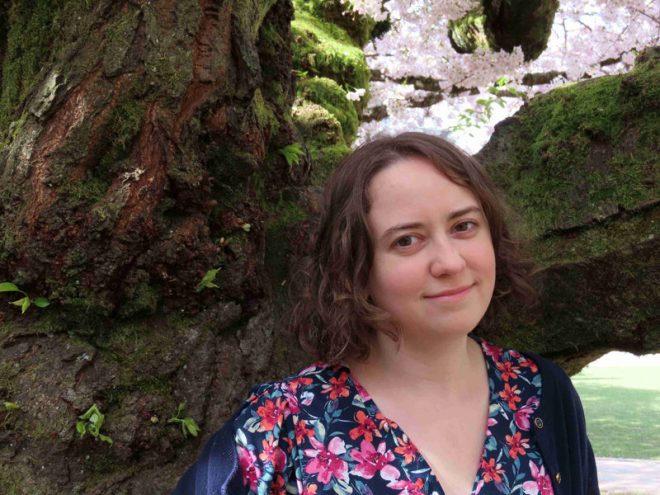
Kathleen Schaefer is a speculative and contemporary fiction writer based in Seattle. Her stories have previously appeared in PodCastle, Solarpunk Magazine, Tales & Feathers, Nature Futures, Apex Publication’s anthology Robotic Ambitions, and more. When not writing, she works as a software engineer and enjoys baking, board games, and appeasing her attention-hungry cat. You can find more of her writing at kathleenschaefer.net
About the Narrator
Heather Thomas

Heather slings jewelry by day but is an aspiring voice actor by night. In her high school years she was classically trained in opera, but now mostly just sings karaoke. She is wildly enthusiastic about all things horror, and has notably curated an impressive collection of earnest, yet awful, dog portraits. “The Stripper” on Pseudopod is her first ever (and first professional!) horror publication. She lives in Denver, Colorado with her husband and her 2 evil cats, Muffin and Banana. Heather’s other narrations can be found on other fine podcasts such as the Creepy podcast, The Wicked Library, The Lift, Tales to Terrify, and The Starship Sofa.
