

Escape Pod 1039: The Many Rebirths of Karina Morita
The Many Rebirths of Karina Morita
by Tim Pratt
My problems all started when I died.
People didn’t die too often on my hab, or anywhere else on the planets and stations of the Standard Curve; we cured illness and aging long ago, but there were still occasional deaths by misadventure. I was flying an ultralight to the outdoor sex and ice cream festival on the Melodious Archipelago when an unexpected updraft sent me spinning out, straight into the side of a familiar mountain (it was hollowed-out and contained an eternal-night dance club). As the meticulously textured stone surface rushed toward my face, I thought, “Oh well, at least I had a backup yesterday.” I’d lose my memories of the morning, sure, but my post-breakfast orgasms hadn’t been any better than usual, and the hollandaise on my dodo eggs was only okay too.
I was supposed to wake up in the cozy rebirth lounge of my own home on the Shimmering Terrace, my consciousness decanted into a fresh clone, as I’d done a dozen times before. Instead, I awoke naked and shivering, stretched out on a long table in a small room with silver walls, while a short woman wearing a pure white jumpsuit and an elaborate crown of stainless steel smiled down at me. “Karina Zephyrus Morita!” she said. “Welcome to the Interval. I’m your technician. I see this is your first time passing through. Don’t worry, we’ll get you assessed and processed quickly.”
I shrieked and sat up on the table. Was I in some kind of clinic? Had there been a mishap with the cloning process? I felt fine, and the bits of me I could see didn’t appear malformed. “What’s happening? Who are you? What is this place?”
The technician cocked her head and shrugged. “It’s the Interval. The place in between lives? Some people call it the Bardo, which isn’t quite right, but it’s a similar concept, if you’re familiar…. No?” She had a clipboard, but it must have actually been some kind of tablet, because she prodded it with her finger and gazed down. “Ah, you’re from a post-scarcity milieu, culturally beyond such concepts due to functional immortality, ha. Okay, so, you died, and this is the afterlife, but the afterlife is just a way station before your soul moves on to a new world.”
“Died? Afterlife?” Vague memories of classic sims about clouds and harps and flames and pitchforks arose. This place didn’t have any of those things, which was both disappointing and reassuring. “But I had a recent backup! My consciousness should have persisted!”
“I don’t know about any of that.” The technician shrugged. “A copy of your consciousness isn’t the same as your intangible immortal soul, and that’s the part of you that moves on. Or maybe every copy of your consciousness gets its own soul, and they all pass through here upon cessation? That’s a nice idea.”
This was a joke, a prank, or maybe a social destabilization Happening orchestrated by the Clatter Society. I swung my legs around to dangle off the table. “I’m getting out of here.”
“That is true,” the technician said cheerfully. “It only takes a few moments for the system to scan your developmental metadata so I can assess the best world for your continued refinement.” The room flashed with a sudden burst of purple light, leaving me blinking and stunned. “Okay, off you go to the next life! Don’t worry, you won’t remember any of this, or anything about your past lives, either, except on a fundamental spiritual level, where those experiences will guide your instincts and insights. Think of it as a fresh start, and an opportunity to learn and grow!”
“This is—” I began, and the next word would have likely been an expletive or a noun modified by an expletive, but the floor dropped out beneath me and I plummeted and—
Found myself sitting in a car in traffic after drop-off at the elementary school, my brain a jagged haze of interlocking and overlapping to-do lists constantly shifting according to a stress-based triage. I looked down at myself and picked a piece of cereal off the front of my red blouse, where it left an oat-milky smear. But at least my little Cassandra was someone else’s problem for the day, and I might even have time to stop and get a latte before I went up to the office to deal with the endless hydra of emails in my inbox—
I screamed and stared around, wide-eyed. Where was I, what was a car, who was my little Cassandra, what was an inbox, what was an elementary school, what was happening, who was I? This was not my world, the glittering array of the Standard Curve, a place of reliable pleasure and safe exploration. This was some kind of a nightmare realm where my brain was crowded with minutiae about immunization schedules and profit-and-loss sheets and some grim ritual called “date night” that involved an entity called a “husband” and which apparently required me to… scrape off most of my body hair? With a piece of sharp metal?
I fumbled with the unfamiliar (yet also totally familiar) door handle and jumped out of the strange boxy conveyance, which led to a chorus of cacophonous honks and shouts from the vehicles around me. Everywhere there were long low buildings and hard black and grey surfaces and sad-looking drooping trees and poles dangling wires. A light hanging on a crossbar changed from red to green and the honking intensified.
“Filter noise!” I shouted, but my perceptual system didn’t respond—maybe I didn’t even have one anymore. There were damp spots under my armpits, and I could faintly smell myself, sweat and some kind of sweetly metallic scent that I assumed was meant to cover up the first odor. I went rushing heedlessly away from my vehicle, across an open stretch of that hard black ground, toward the trees, because stunted or not, at least they were trees.
A moment after I stepped over a double yellow line painted on the ground, one of the vehicles, a big one, struck me so hard the impact was a sensation that was totally all consuming and—
This time I sat up in the silver room screaming, and the technician winced. “Traumatic exit that time, huh? Well, better luck next, Karina Finnegan née Morita—”
I jumped off the table, seized her by the shoulders, and shook her. “You! You again! What was that horrible place? Why did you send me there?”
She stared at me, then gently removed my hands, half-turned away, and poked at her clipboard. “Oh. Oh dear. Very unusual. You’re not supposed to remember any of this—not me, and not your old life. But the discontinuity in your consciousness isn’t complete, there’s a resumption of connectivity…. Do you remember being a child in that most recent world?”
“What? No!” Except… I did, sort of, if I thought about it, but it was like reading someone else’s boring diary. “I just found myself in this thing called a car, and there were all these noises, and then I was struck by a fast-moving object and it hurt, my nerve-blocks didn’t even kick in!”
“Ah, no, they wouldn’t have that kind of tech. You won’t be going to any milieus with nerve-block technology ever again, probably,” She sounded apologetic. “I’m not sure why your consciousness and memory returned to you like that. I’m going to open a support ticket and see if we can figure it out. Hopefully we’ll get it all sorted. In the meantime, we’re going to send you on to your next stop on the road to perfection. If your memory does come back again… try not to panic, hmm? Just muddle on as best you can, the longer you live, the more you can learn. All right, here we go.” That all-encompassing purple light strobed again. “Think of it as a fresh start, and an opportunity to learn and grow!”
“No, stop, you can’t—” The floor dropped away beneath me.
Next time I swam up into consciousness I was sitting in a room that smelled powerfully of solvents while a black-haired woman painted my fingernails pale pink. There were other people around me, all chattering away, and the woman was talking to me, too, telling me a long story about her daughter’s terrible girlfriend. I understood her language perfectly. I knew that my name was Karina Morita, no middle name; my culture didn’t really do those. I knew that I was twenty-four years old, that I was a junior publicist at a PR firm, I was single and tired of dating, and that this twice-monthly visit to the salon was one of my life’s greatest pleasures. A quick scan through this other version of me’s memories revealed bad sex (and with only one gender of partners), bad food (hacked from dead animals in some cases), limited travel (to bad places, so perhaps a blessing), and horrific physical ailments (mucus running from the holes in my face).
But I did not want to return to that strange place with the silver walls and the useless technician, and I understood that I lived a life of relative privilege compared to most people in this “mileu.” I wondered if I was time-traveling; was this the past of my own beautiful home world? I’d never paid any attention to history. I wasn’t a scholarly type. In what I was grudgingly thinking of as my “first life,” I mostly indulged myself, traveled to the varied wonders of the Standard Curve, and did a little semiprofessional mech-racing on the side—normal things, like anyone else.
I decided to try to make the best of my situation. Maybe this whole experience was my brain setting off strange fireworks at the moment of impact with that mountainside. Maybe I was stuck in some new kind of immersive sim, a fictional scenario that erased your memory of entering the sim in the first place. Or maybe… it was exactly what it seemed. “Reincarnation,” but not as a bug or bunny rabbit or underprivileged person, but just as another version of yourself, in another world.
After my nails were done, I followed the promptings of my deeper mind to hand over a little rectangle of plastic and then poked at a screen (payments, and things called tips? How bizarre), and then went out to my vehicle, a sleeker and shinier version of the one I’d fled last time. At least this car drove itself, so I wasn’t expected to figure that out. It took me to an apartment halfway up a stubby tower, a set of rooms where I would not have deigned to keep a disfavored pet back home, but I gathered for this milieu it was considered “very nice.”
There was a lot of wine in the apartment, drinkable even, so that was good. I resolved to stay here, and learn the ways of this place, and make the best life for myself that I could—
I lasted for ten days (using something called “sick time” to avoid the unbearable tedium of my job in “publicity,” a concept I chose not to think deeply about). Then I was seized by horrible abdominal cramps, agony of a degree I’d never imagined possible, and I bled, from a place you’d never want to bleed. My deeper mind assured me this was a regular occurrence. This, of course, was intolerable to me. Apparently cutting oneself with “razors” was a common way to escape life here, but I didn’t have any, since this version of me underwent an awful ritual involving hot wax to deal with unwanted hair instead; they didn’t have selective hair growth mods in this hellscape. But my deeper mind told me that wine and certain pills would solve the problem of living too, and so—
I didn’t scream this time. I sat up, weary, and looked at the technician. “I still remembered.”
“I can see that.” She poked at the clipboard. “Your consciousness just snapped awake after about two and a half decades, both times. I’ve never heard of this happening before. Maybe remembering this way is… part of your process? It’s definitely nicer to believe this is happening on purpose, right? That there’s an infallible order, and not that there are just… glitches, sometimes.”
I needed to understand. Understanding would help, right? It must. “Please explain to me what is going on. Why is this happening to me?”
The technician went hmm, then a stool on wheels came rolling out of a corner of the silver room. I didn’t remember seeing a stool there before, but I was distracted. The technician sat down and put the clipboard on her lap and said, “It’s not just happening to you. It happens to everyone. It’s about the perfection of the soul. Think of it like… triple distillation, the way people make really pure alcohol. Every new milieu cooks off some of your impurities. Every time you die, you are reborn into a new world, one that has different things to teach you—to expose you gradually to new hardships, to help reveal the ore of your character hidden beneath the base rock of your unconsidered inclinations. To help you become better. It’s an iterative refinement process, and it goes on and on until… well, until you’re finished, I guess.”
I put my face in my hands. “New hardships? You mean every world I go to is going to get worse?”
She swiveled back and forth a little on the stool, turning her hips. “I wouldn’t necessarily say they get worse. Not on a systemic or social level anyway. Each milieu get more difficult, for you, personally. The idea is, each world makes you stronger, more resilient, better at adapting. Even if you don’t have conscious memories, the soul remembers.” She paused. “Well, you’re an outlier. But each new life is tailored to you personally, to teach you things you can benefit from. Like, that last world, it was pretty nice actually, they were about to figure out reliable fusion energy production even. It’s just that you personally worked too much in that world, and didn’t value love—”
“Are these worlds real, or simulations?”
The technician held up both hands, palms up, then dropped them. “Couldn’t tell you. We mostly think it’s a distinction without a difference. All the people in them think they’re real, so, close enough.”
“But what’s the point of all this?” I demanded. “What’s the ultimate goal?”
The technician blinked. “Perfection. Didn’t I say?”
“But what happens when I’m perfect? And who decides what perfection even means?”
She snorted. “Oh, that’s way above my pay grade. Ha ha. Not that I get paid.”
I knew what “paying” was now, at least, so I understood what she meant. “If you just work here, who’s in charge?”
“Ah, that’s the most popular topic of conversation in the break room,” she said. “Some kind of god or gods, that’s the most popular opinion. Some say it’s aliens. One interesting theory is that there’s some best possible version of each of us in the future, and that future person is trying to make sure we achieve the perfection that permits them to exist? That one’s a little convoluted for my taste. I lean toward the idea that it’s some kind of machine intelligence running an experiment, maybe to decide whether it’s worth keeping organic beings around at all. Or it could be that a machine intelligence set up the experiment, and then broke down, and the experiment is just… still running for no reason. Maybe someday we’ll find out!”
There were implications here. “So you’re… like me? This happened to you, too? Dying and waking up and moving on?”
She nodded. “This last time, I woke up here, and I was given this job—just running the scanner and choosing the next best world based on the data. Presumably I’ll die here at some point and go elsewhere? But I’ve never had a coworker die, so…. maybe this is my perfection. Wow, that’s depressing, isn’t it?”
I seized on a thread of hope. “If you decide where to send me, you can send me back, back home, I should even have a body there already, my clone—”
“Nice try,” she said, and the purple light strobed. “Think of it as a fresh start, and an opportunity to learn and—”
“Shut up!” I screamed into my new reality.
Now that I knew the worlds were going to get more difficult for me, personally, each time, I tired much harder to last in each one. I learned there were medicines to treat the pain of the body, though the best methods caused new problems eventually, and it took me a few worlds to learn the proper balance and not die from too much of a good thing.
In one world I was a nurse and the mother of triplet toddlers and my feet ached all the time; in the next I was a college professor having almost adequate sex with one of my students until she got upset about something and told my employers and my meager comforts all came crashing down; in another I spent all day stooping over picking tomatoes while eight-foot tall figures in chitinous black armor chittered orders at us. I didn’t last long there after I threw a tomato at one of them.
When I returned to the Interval, I didn’t bother to argue with the technician anymore, just submitted to the scan and my new deployments.
I resolved that even if my worlds were going to get harder and harder for me, I would take steps to mitigate those horrors as much as possible—and I had an advantage, didn’t I? I carried knowledge from other worlds. I had a good mind, it turned out, even though I’d never used it for much back home. I had a particularly fine grasp of technical matters, and in each life I studied the most valuable inventions a given world possessed. (It was just a shame I’d never done that with the everyday miracles back home.) Over time I developed expertise in everything from broadcast technology to transistors, communication satellites and radios, antibiotics and microwaves, radar and powered flight. Those studies didn’t always help me; if you’re born in a wooden shack on a scoured island, knowing how to build a fusion reactor is no help at all, and when you’re a factory drudge in the choking smogs of the Eternal Londinium, your automaton overseer isn’t interested in your ideas about improving the assembly lines.
But in other worlds, where I had some initial resources, and where I was considered attractive and well-spoken, I was sometimes able to parlay my knowledge and insights into more comfortable situations (in worlds where women could do such things, at least). I was cheated and taken advantage of a lot at first, but I learned how to protect my interests over time, and how to balance the natural generosity that came from my life in a post-scarcity reality with the pragmatism necessary to survive in places where competition was ferocious.
In some worlds, after successfully attending to my basic needs, I sought love; in some of them, I found it; in others, I didn’t seek it at all, but it ambushed me anyway. Love enriched those lives in so many ways… but because I could remember my husbands and wives and spouses after they were lost, those experiences turned into thorns, pricking my mind even in the new worlds that opened before me. I began to turn away from those feelings when they arose, as a hedge against future pain. I felt I’d learned enough about the human heart at that point; surely my remaining needs for perfection were in other areas?
In one world, my parents (but they weren’t my parents; not my original ones; they never were; isn’t that strange?) were well-off financially, but emotionally cold and demanding. The relative privilege enabled me to excel in my studies, however, and by the time I “woke up” I was in graduate school, doing pure mathematics to annoy my practical father. I swiftly pivoted to applied physics—it wasn’t hard, once I talked to the most avaricious eminent professor in the department, and showed him a few drawings—and that was the best world yet. I built a business, and it became an empire. The advances I made there, especially in the energy sector, made me wealthy, and also made the world substantially better for most of its inhabitants. That milieu was nowhere near the glory of the Standard Curve, but I was proud of myself for setting it on the beginning of a path that might eventually lead there.
I was also finally able to afford decent food, and easily attracted an acceptable number and variety of sexual partners. Sometimes I got high or drunk and talked about the Standard Curve, and my friends thought I was describing a science fiction story, or my vision of the future. The latter was closer.
I departed that world at the age of one hundred and six, floating away on a sea of drugs in a bed in my own home, attended by loyal employees and tearful protégés. I would have liked to stay longer, but I never studied life-extension technology on the Standard Curve, and I’d never been to another world that even approached my home’s capabilities in that area.
Back in the Interval, I sat up, pleased to be in the same young strong body I’d worn every time I arrived here. Even with all the money in the world, in most worlds, pain is inescapable, and many forms of it increase with age.
“I cheated,” I told the technician gleefully. “I’ve been cheating for ages. I’m using the knowledge of my past lives to improve my circumstances in every horrible world you drop me into!”
She raised one eyebrow, then chuckled. “You mean you’re learning and adapting? Which is the entire point of the process?”
I scowled. “I’m not supposed to remember things like how cold fusion works, though! It’s an unfair advantage, and I’m exploiting it!”
“Bringing that kind of technology to fruition in that last milieu you were in?” She scrolled her clipboard. “That required technical mastery, with the details held entirely in your own mind, without so much as a textbook or even a notepad to consult. It also took business savvy, a keen understanding of human psychology, attention to detail, the ability to learn from failure, resilience, and a lot of other qualities that we track in your metadata. I hate to tell you this, but… you’re just getting better. The system works.”
“Oh, shut up.” I laughed, though. For the first time, I was curious to see what was coming next, instead of just resigned. What was the next challenge going to be, and how was I going to crush it? “Where am I going this time?”
The purple light flashed, and the consulted her clipboard. “Ah, well, it looks like the best option is a place where your old strategies aren’t going to be much help. This is a real outlier world, different from most of the others you’ve seen, and pretty rough honestly. I… might be seeing you again sooner rather than later.”
I gave her a savage grin. “I’ll take that as a challenge, technician.”
“Best of luck, Karina ‘The Clean Energy Queen’ Morita. Think of it as a fresh start, and an opportunity to—”
“Excel!” I shouted as the floor opened beneath me.
I came to on my hands and knees in mud that stank of blood. I lifted my head, and saw bodies all around me, some human corpses dressed in fur and leather, and some more bizarre: scaly humanoids with lizard heads, wearing armor made of what looked like glossy beetle shells. I struggled to my feet, noting my own fur and leather garments, and the knives at my belt, and a great hammer at my feet, blunt on one side, with a sharp spike on the other. I picked up the hammer, my deeper mind telling me it was my favored weapon. Everyone around me was dead, and I knew I was the last survivor of a skirmish with the members of some snake cult, who’d been transformed by their devotions. My name was Karina the Red, my village was gone, my people had been annihilated, but I still lived. And I wanted revenge—
“Screw that,” I said aloud. I looked around at the mud, the distant mountains, the sun hanging low and shrouded red, and I grinned.
Once I had a working steam engine sorted out, I was going to become empress of this place, and after I taught the locals about aspirin and indoor plumbing, there would be statues of me standing tall for ten thousand years.
Also, my deeper mind told me that some of the snake cults promised immortality… and that was definitely worth looking into.
Host Commentary
And we’re back! Again, that was “The Many Rebirths of Karina Morita”, by Tim Pratt, narrated by Isabel J. Kim.
This was such a delightful story. It definitely made me want to visit the Standard Curve…even if I didn’t want to follow Karina’s entire trajectory. But honestly, that kind of holds appeal, too. The thought of being able to use past knowledge and apply it to new lives? As Karina says, it feels like cheating. But it’s nice to watch Karina grow as a person, and touch on all the alternate timelines she gets dropped into.
Pratt does one more thing with the fantastical twist in this story that I tend to really like, which is–she doesn’t over-explain it. The point is not who set this up and why and how. The point is to watch Karina improve. I’d certainly be curious to hear the explanation of these underpinnings…but since Pratt leaves this unexplained, the focus of the story stays on Karina. And with my curiosity unfulfilled, it leaves intriguing questions open, and I continue to wonder about the story.
In general housekeeping news, Escape Pod is OPEN to general submissions until May 31st, 2026. You can find all the info at escapepod.org under our guidelines, so if you’ve been thinking about submitting something to us, why not hop on over there and check that out!
Escape Pod is part of the Escape Artists Foundation, a 501(c)(3) non-profit, and this episode is distributed under the Creative Commons Attribution-NonCommercial-NoDerivatives 4.0 International license. Don’t change it. Don’t sell it. Please, go forth and share it.
How do you share it, you ask? Well! In addition to your social media of choice, consider rating and/or reviewing us on podcast listening sites, such as Apple or Google. More reviews makes for more discoverability makes for more Escape Pod for you. You can’t lose.
Escape Pod relies on the generous donations of listeners exactly like you. And remember that Patreon subscribers have access to exclusive merchandise and can be automatically added to our Discord, where you can come chat with other fans as well as our staff members. So! If you enjoyed our story this week then consider going to escapepod.org or patreon.com/EAPodcasts and casting your vote for more stories that go looking for immortality with the Snake Cult.
Our opening and closing music is by daikaiju at daikaiju.org.
And our closing quotation this week is from Martha Graham, who said: Practice is a means of inviting the perfection desired.”
Thanks for listening! And have fun.
About the Author
Tim Pratt

Tim Melody Pratt (genderfluid, any pronouns) lives in Berkeley, California with spouse Heather Shaw and their son River.
Pratt’s fiction and poetry have appeared in The Best American Short Stories, The Best American Erotica, The Year’s Best Fantasy and Horror, The Mammoth Book of Best New Horror, Strange Horizons, Realms of Fantasy, Asimov’s, Lady Churchill’s Rosebud Wristlet, Subterranean, and Clarkesworld, among many other places (for complete details, see the bibliography). She writes a new story every month for patrons at Patreon: www.patreon.com/timpratt
About the Narrator
Isabel J. Kim
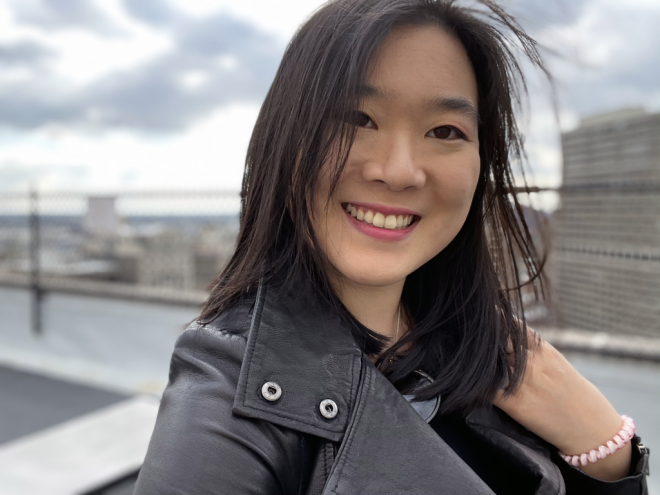
Isabel J. Kim is a Korean-American speculative fiction writer based in New York City. She is a Shirley Jackson Award winner, a Hugo, Nebula, and Astounding Award finalist, and her short fiction has been published in Clarkesworld, Lightspeed, and Strange Horizons, among other venues. Her work has been reprinted in the Best American Science Fiction and Fantasy 2023 and 2024 and translated into Chinese and Japanese. When she’s not writing, she’s either practicing law or co-hosting her internet culture podcast Wow if True — both equally noble pursuits. Find her at isabel.kim or @isabel.kim on Twitter.
