

Escape Pod 1035: We Who Live in the Heart (Part 1 of 3)
We Who Live in the Heart
By Kelly Robson
Ricci slipped in and out of consciousness as we carried her to the anterior sinus and strapped her into her hammock. Her eyelids drooped but she kept forcing them wide. After we finished tucking her in, she pulled an handheld media appliance out of her pocket and called her friend Jane.
“You’re late,” Jane said. The speakers flattened her voice slightly. “Are you okay?”
Ricci was too groggy to speak. She poked her hand through the hammock’s electrostatic membrane and panned the appliance around the sinus. Eddy and Chara both waved as the lens passed over them, but Jane was only interested in one thing.
“Show me your face, Ricci. Talk to me. What’s it like in there?”
Ricci coughed, clearing her throat. “I dunno. It’s weird. I can’t really think.” Her voice slurred from the anesthetic.
I could have answered Jane, if she’d asked me. The first thing newbies notice is how strange it smells. Human olfaction is primal; scents color our perceptions even when they’re too faint to describe. Down belowground, the population crush makes it impossible to get away from human funk. Out here, it’s the opposite, with no scents our brains recognize. That’s why most of us fill our habs with stinky things – pheromone misters, scented fabrics, ablative aromatic gels.
Eventually, Ricci would get around to customizing the scentscape in her big new hab, but right then she was too busy trying to stay awake. Apparently she’d promised Jane she’d check in as soon as she arrived, and not just a quick ping. She was definitely hurting but the call was duty.
“There’s people. They’re taking care of me.” Ricci gazed blearily at our orang. “I was carried in by a porter bot. It’s orange and furry. Long arms.”
“I don’t care about the bot. Tell me about you.”
“I’m fine, but my ears aren’t working right. It’s too noisy.”
We live with a constant circulatory thrum, gassy gurgles and fizzes, whumps, snaps, pops, and booms. Sound waves pulse through every surface, a deep hum you feel in your bones.
Jane took a deep breath, let it out with a whoosh. “Okay. Go to sleep. Call me when you wake up, okay?”
Ricci’s head lolled back, then she jerked herself awamy ke.
“You should have come with me.”
Jane laughed. “I can’t leave my clients. And anyway, I’d be bored.”
Ricci squeezed her eyes shut, blinked a few times, then forced them wide.
“No you wouldn’t. There’s seven other people here, and they’re all nuts. You’d already be trying to fix them.”
Vula snorted and stalked out of the sinus, her long black braids slapping her back. The rest of us just smiled and shook our heads. You can’t hold people responsible for what they say when they’re half-unconscious. And anyway, it’s true — we’re not your standard moles. We don’t want to be.
Only a mole would think we’d be bored out here. We have to take care of every necessity of life personally — nobody’s going to do it for us. Tapping water is one example. Equipment testing and maintenance is another. Someone has to manage the hygiene and maintenance bots. And we all share responsibility for health and safety. Making sure we can breathe is high everyone’s our priority list, so we don’t leave it up to chance. Finally, there’s atmospheric and geographical data gathering. Mama’s got to pay the bills. We’re a sovereign sociopolitical entity, population: eight, and we negotiate our own service contracts for everything.
But other that, sure, we have all the free time in the world. Otherwise what’s the point? We came out here to get some breathing room — mental and physical. Unlike the moles, we’ve got plenty of both.
Have you ever seen a tulip? It’s a flowering plant. No nutritional value, short bloom. Down belowground, they’re grown in decorative troughs for special occasions — ambassadorial visits, arts festivals, sporting events, that sort of thing.
Anyway. Take a tulip flower and stick an ovoid bladder where the stem was and you’ve got the idea. Except big. Really big. And the petals move. Some of us call it Mama. I just call it home.
The outer skin is a transparent, flexible organic membrane. You can see right through to the central organ systems. The surrounding bladders and sinuses provide structure and protection. Balloons inside a bigger balloon, filled with helium and hydrogen. The whole organism ripples with iridescence.
We live in the helium-filled sinuses. If you get close enough, you can see us moving around inside. We’re the dark spots.
While Ricci slept, I called everyone to the rumpus room for a quick status check. All seven of us lounged in the netting, enjoying the free flowing oxygen/hydrogen mix, goggles and breathers dangling around our necks.
I led the discussion, as usual. Nobody else can ever be bothered.
“Thoughts?” I asked.
“Ricci seems okay,” said Eddy. “And I like what’s-her-name. The mole on the comm.”
“Jane. Yeah, pretty smile,” said Bouche. “Ricci’s fine. Right Vula?”
Vula frowned and crossed her arms. She’d hooked into the netting right next to the hatch and looked about ready to stomp out.
“I guess,” she said. “Rude, though.”
“She was just trying to be funny,” said Treasure. “I can never predict who’ll stick and who’ll bounce. I thought Chara would claw her way back down belowground. Right through the skin and nosedive home.”
Chara grinned. “I still might.”
We laughed, but the camaraderie felt forced. Vula had everyone on edge.
“We’ll all keep an eye on Ricci until she settles in,” Eleanora said. “Are we good here? I need to get back to training. I got a chess tournament, you know.”
“You always have a tournament.” I surveyed the faces around me, but it didn’t look like anyone wanted to chat.
“As long as nobody hogs the uplink, I never have any problems,” said Bouche. “Who’s training Ricci?”
“Who do you think?” I said. We have a rule. Whoever scared off the last one has to train the replacement.
We all looked at Vula.
“Shit,” she said. “I hate training newbies.”
“Stop running them off then,” said Chara. “Be nice.”
Vula scowled, fierce frown lines scoring her forehead. “I’ve got important work to do.”
No use arguing with Vula. She was deep in a creative tangle, and had been for a while..
“I’ll do it,” I said. “We better train Ricci right if we want her to stick.”
When Ricci woke up, I helped her out of the hammock and showed her how to operate the hygiene station. As soon as she’d hosed off the funk, she called Jane on her appliance.
“Take off your breather for a moment,” Jane said. “Goggles too. I need to see your face.”
Ricci wedged her fingernails under the seal and pried the off her breather. She lifted her goggles. When she grinned, deep dimples appeared on each cheek.
Jane squinted at her through the screen. She nodded, and Ricci replaced the breather. It attached to her skin with a slurp.
“How do I look?” Ricci asked. “Normal enough for you?”
“What’s the failure rate on that thing?”
“Low,” Ricci said.
Point two three percent. Which is low unless you’re talking about death. Then it’s high. But we have spares galore. Safety nests here, there, and everywhere. I could have chimed in with the info but Jane didn’t want to hear from me. I stayed well back and let Ricci handle her friend.
“Has anyone ever studied the long-term effects of living in a helium atmosphere?” Jane asked. “It can’t be healthy.”
“Eyes are a problem.” Ricci tapped a finger on a goggle lens. “Corneas need oxygen so that’s why we wear these. The hammocks are filled with air, so we basically bathe in oxygen while we’re sleeping. But you’re right. Without that the skin begins to slough.”
Jane made a face. “Ugh.”
“There’s air in the common area, too — they call it the rumpus room. That’s where they keep the fab and extruder. I’m supposed to be there now. I have to eat and then do an orientation session. Health, safety, all that good stuff.”
“Don’t forget to take some time to get to know your hab-mates, okay?”
“I met them when I got here.”
“One of them is Vula, the artist, right? The sculptor. She’s got to be interesting.”
Ricci shrugged. “She looked grumpy.”
I was impressed. Pretty perceptive for someone who’d been half-drowned in anesthetic.
“What’s scheduled after training?”
“Nothing. That’s the whole point of coming here, right?”
“I wondered if you remembered.” A smile broke over Jane’s face, star-bright even when glimpsed on a small screen at a distance. “You need rest and recreation.”
“Relaxation and reading,” Ricci added.
“Maybe you’ll take up a hobby.”
“Oh, I will,” said Ricci. “Count on it.”
Yes, I was spying on Ricci. We all were. She seemed like a good egg, but with no recourse to on-the-spot conflict intervention, we play it safe with newbies until they settle in. Anyone who doesn’t like it can pull down a temporary privacy veil to shield themselves from the bugs, but most don’t bother. Ricci didn’t.
Plus we needed a distraction.
Whether it’s half a million moles in a hole down belowground or eight of us floating around in the atmosphere, every hab goes through ups and downs. We’d been down for a while. Some of it was due to Vula’s growly mood, the worst one we’d seen for a while, but really, we just needed a shake-up. Whether we realized it or not, we were all looking to Ricci to deliver us from ourselves.
During orientation, Ricci and I had company. Bouche and Eddy claimed they needed a refresher and tagged along for the whole thing. Chara, Treasure, and Eleanora joined us halfway through. Even Vula popped out of her hab for a few moments, and actually made an effort to look friendly.
With all the all the chatter and distraction, I wasn’t confident Ricci’s orientation had stuck, so I shadowed her on her first maintenance rotation. The workflow is fully documented, every detail supported by nested step-by-steps and supervised by dedicated project management bugs that help take human error out of the equation. But I figured she deserved a little extra attention.
Life support is our first priority, always. We clear the air printers, run live tests on the carbon dioxide digesters, and ground-truth the readings on every single sensor. It’s a tedious process, but not even Vula complains. She likes to breathe as much as any of us.
Ricci was sharp. Interested. Not just in the systems that keep us alive, but in the whole organism, its biology, behavior, and habitat. She was even interested in clouds around and the icy, slushy landscape below. She wanted to know about the weather patterns, wind, atmospheric layers — everything. I answered as best I could, but I was out of the conversational habit.
That, and something about the line of her jaw had me tongue-tied.
“Am I asking too many questions, Doc?” she asked as we stumped back to the rumpus room after checking the last hammock.
“Let’s keep to the life-and-death stuff for now,” I said.
Water harvesting is the next priority. To get it, we have to rise to the aquapause. There, bright sunlight condenses moisture on the skin and collects in the dorsal runnels, where we tap it for storage.
Access to the main inflation gland is just under the rumpus room. Ricci squeezed through the elasticized access valve. The electrostatic membrane pulled her hair into spikes that waved at the PM bots circling her head. I stayed outside and watched her smear hormone ointment on the marbled surface of the gland. Sinuses creaked as bladders began to expand. As we walked through the maze of branching sinuses, I showed her how to brace against the roll and use the momentum to pull herself through the narrow access slots. Once we got to the ring-shaped fore cavity, we hooked our limbs into the netting and waited.
Rainbows rippled across the expanded bladder surfaces. We were nearly spherical, petals furled, and the wind rolled us like an untethered balloon. The motion makes some newbies sick, and they have to dial up anti-nauseant. Not Ricci. She looked around with anticipation, as if she were expecting to see something amazing rise over the vast horizon.
“Do you ever run into other whales?” she asked.
“I don’t much care for that term,” I said. It came out gruffer than I intended.
A dimple appeared at the edge of her breather. “Have you been out here long, Doc?”
“Yes. Ask me an important question.”
“Okay.” She waved her hand at the water kegs nested at the bottom of the netting, collapsed into a pile of honeycomb folds. “Why don’t you carry more water?”
“That’s a good question. You don’t need me to tell you though. You can figure it out. Flip through your dash.”
The dimple got deeper. Behind her darkened goggles, her eyelids flickered as she reviewed her dashboards. Naturally it took a little while; our setup was new to her. I rested my chin on my forearms and waited.
She surfaced quicker than I expected.
“Mass budget, right? Water is heavy.”
“Yes. The mass dashboard also tracks our inertia. If we get too heavy, we can’t maneuver. And heavy things are dangerous. Everything’s tethered and braced, and we have safety nets. But if something got loose, it could punch through a bladder wall. Even through the skin, easy.”
Ricci looked impressed. “I won’t tell Jane about that.”
We popped into the aquapause. The sun was about twenty degrees above the horizon. Its clear orange light glanced across the thick violet carpet of helium clouds below. Overhead, the indigo sky rippled with stars.
Bit of a shock for a mole. I let Ricci ogle the stars for a while. Water ran off the skin, a rushing, cascading sound like one of the big fountains down belowground. I cleared my throat. Ricci startled, eyes wide behind her goggles, then she climbed out of the netting and flipped the valve on the overhead tap. Silver water dribbled through the hose and into the battery of kegs, slowly expanding the pleated walls.
Ricci didn’t always fill the quiet spaces with needless chatter. I liked that. We worked in silence until the kegs were nearly full, and when she began to question me again, I welcomed it.
“Eddy said you were one of the first out here,” Ricci said. “You figured out how to make this all work.”
I answered with a grunt, and then cursed myself. If I scared her away Vula would never let me forget it.
“That’s right. Me and a few others.”
“You took a big risk.”
“Moving into the atmosphere was inevitable,” I said. “Humans are opportunistic organisms. If there’s a viable habitat, we’ll colonize it.”
“Takes a lot of imagination to see this as viable.”
“Maybe. Or maybe desperation. It’s not perfect but it’s better than down belowground. Down there, you can’t move without stepping on someone. Every breath is measured and every minute is optimized for resource resilience. That might be viable, but it’s not human.”
“I’m not arguing.” Ricci’s voice pitched low, thick with emotion as she gazed at the stars in that deep sky. “I love it here.”
Yeah, she wasn’t a mole anymore. She was one of us already.
One by one, the kegs filled and began flexing through their purification routine. We called in the crablike water bots and ran them through a sterilization cycle.
Water work done, the next task was spot-checking the equipment nests. I let Ricci take the lead, stayed well back as she jounced through the cavities and sinuses. She was enthusiastic, confident. Motivated, even. Most newbies stay hunkered in their hammocks for a lot longer than her.
We circled back to the rumpus room, inventoried the nutritional feedstock, and began running tests on the hygiene bots. I settled into the netting and watched Ricci pull a crispy snack out of the extruder.
“You must know all the other crews. The ones who live in the…” Ricky struggled to frame the concept without offending me.
“You can call them whales if you want. I don’t like it, but I’ve never managed to find a better word.”
She passed me a bulb of cold caffeine.
“How often do you talk to the people who live in the other whales, Doc?”
“We don’t have anything to do with them. Not anymore.”
“How come?”
“The whole reason we came out here is so we don’t have to put up with anyone else’s crap.”
“You never see the other whales at all? Not even at a distance?”
I drained the bulb. “These organisms don’t have any social behavior.”
“But you must have to talk to them sometimes, don’t you? Share info or troubleshoot?”
I collapsed the bulb in my fist and threw it to a hygiene bot.
“You lonely already?”
Ricci tossed her head back and laughed, a full belly guffaw. “Come on, Doc. You have to admit that’s weird.”
She was relentless. “Go ahead and make friends with the others if you want,” I growled. “Just don’t believe everything they say. They’ve got their own ways of doing things, and so do we.”
We checked the internal data repeaters and then spent the rest of the shift calibrating and testing the sensor array — all the infrastructure that traps the data we sell to the atmospheric monitoring firms. I kept my mouth shut. Ricci maintained an aggressive cheerfulness even though I was about as responsive as a bot. But my glacier-like chilliness — more than ten years in the making — couldn’t resist her. My hermit heart was already starting to thaw.
If I’d been the one calling Jane every day, I would have told her the light is weird out here. We stay within the optimal thermal range, near the equator where the winds are comparatively warm and the solar radiation helps keep the temperature in our habitat relatively viable. That means we’re always in daylight, running a race against nightfall, which is good for Mama but not so good for us. Humans evolved to exist in a day-night cycle and something goes haywire in our brains when we mess with that. So our goggles simulate our chosen ratio of light and dark.
Me, I like to alternate fifty-fifty but I’ll fool with the mix every so often just to shake things up. Vula likes the night so she keeps things dimmer than most. Everyone’s different. That’s what the moles don’t realize, how different some of us are.
“I did a little digging, and what I found out scared me,” Jane said the next time Ricci checked in. “Turns out there’s huge gaps in atmospheric research. The only area that’s really well monitored is the equator, and only around the beanstalk. Everywhere else, analysis is done by hobbyists who donate a few billable hours here and there.”
Ricci nodded. “That’s what Doc said.”
Hearing my name perked me right up. I slapped down two of my open streams and gave their feed my whole attention.
“Nobody really knows that much about the organism you’re living inside. Even less about the climate out there, and nearly nothing about the geography, not in detail. I never would have supported this decision if I’d realized how…” Jane’s pretty face contorted as she searched for the word. “How willy-nilly the whole situation is. It’s not safe. I can’t believe it’s even allowed.”
“Allowed? Who can stop us? People go where they want.”
“Not if it’s dangerous. You can’t just walk into a sewage treatment facility or air purification plant. It’s unethical to allow people to endanger themselves.”
Ricci snorted, fouling the valves on her breather and forcing her to take a big gulp of helium through her mouth.
“Not all of us want to be safe, Jane.” The helium made her voice squeaky.
Jane’s expression darkened. “Don’t mock me. I’m worried about you.”
“I know. I’m sorry,” Ricci squeaked. She exhaled to clear her lungs and took a deep slow breath through her nose. Her voice dropped to its normal register. “Listen, I’ve only been here a few days”
“Six,” Jane said.
“If I see anything dangerous, you’ll be the first to know. Until then, don’t worry. I’m fine. Better than fine. I’m even sleeping. A lot.”
That was a lie. The air budget showed Ricci hadn’t seen much of the inside of her hammock. But I wasn’t worried. Exhaustion would catch up with her eventually.
“There’s something else,” Jane said. “I’ve been asking around about your hab-mates.”
“Vula’s okay. It’s just that lately none of her work has turned out the way she wants. You know artists. Their professional standards are always unreachable. Set themselves up to fail.”
“It’s not about Vula, it’s Doc.”
Ricci bounced in her netting. “Oh yeah? Tell me. Because I can’t get a wink out of that one. Totally impervious.”
I maximized the feed to fill my entire visual field. In the tiny screen in Ricci’s hand, Jane’s dark hair trailed strands across her face and into her mouth. She pushed them back with an impatient flick of her fingers. She was in an atrium, somewhere with stiff air circulation. I could just make out seven decks of catwalk arching behind her, swarming with pedestrians.
“Pull down a veil,” Jane said. “You might have lurkers.”
“I do,” Ricci answered. “Four at least. I’m the most entertaining thing inside Mama for quite a while. It doesn’t bother me. Let them lurk.”
But Jane insisted, so Ricci pulled down a privacy veil and the bug feed winked out.
I told myself whatever Jane had found out didn’t matter. It would bear no relation to reality. That’s how gossip works — especially gossip about ancient history. But even so, a little hole opened up under my breastbone, and it ached.
Only six days and I already cared what Ricci thought. I wanted her to like me. So I set about trying to give her a reason.
A few days later, we drifted into a massive storm system. Ricci’s first big one. I didn’t want her to miss it, so I bounced aft and hallooed to her at a polite distance from her hab. She was lounging in her netting, deep in multiple streams, twisting a lock of her short brown hair around her finger.
She looked happy enough to see me. No wariness behind her gaze, no chill.
We settled in to watch the light show. It was an eye-catcher. Bolts zagged to the peaks of the ice towers below, setting the fog alight with expanding patches of emerald green and acid magenta.
Two big bolts forked overhead with a mighty whump. Ricci didn’t even jump.
“What was that?” she asked.
I was going to stay silently mysterious, but then remembered I was trying to be friendly.
“That,” I said, “was lunch.”
A dark splotch began to coalesce at the spot where the two bolts had caressed each other, a green and violet pastel haze in the thin milky fog. We banked slowly, bladders groaning, massive sinus walls clicking as we changed shape to ride the wind currents up, up, and then the massive body flexed just enough to reveal two petals reaching into the coalescing bacteria bloom.
Ricci launched herself out of the netting and clung to the side of her hab, trying to get a better view of the feeding behavior. When the bloom dissipated, she turned to me.
“That’s all it does, this whale? Just search for food?”
“Eat, drink, and see the sights,” I said. “What else does anyone need from life?”
Good company, I thought, but I didn’t say it.
The lightshow went on for hours. Ricci was fascinated from start to finish. Me, I didn’t see it. I spent the whole storm watching the light illuminate her face.
What else does anyone need from life? That was me trying to be romantic. Clumsy. Also inaccurate.
When we first moved out here, my old friends and I thought our habs would eventually become self-contained. Experience killed that illusion pretty quick. We’re almost as dependent on the planetary civil apparatus as anyone.
Without feedstock, for example, we’d either starve or suffocate – not sure which would happen first. It has a lot of mass, so we can’t stockpile much.
Then there’s power. Funding it is a challenge when you’re supplying eight people as opposed to eight million. No economy of scale in a hab this size. It’s not the power feed itself that’s the problem, but the infrastructure. We’re always on the move, so the feed has to follow us around and provide multiple points of redundancy. Our ambient power supply costs base market value plus a massive buy-back on the research and development.
Data has to follow us around too, but we don’t bother with redundancy. It’s not critical. You’d think it was more important than air, though, if you saw us when the data goes down. Shrieking. Curses. Bouche just about catatonic (she’s a total media junkie). Eleanora wall-eyed with panic especially if she’s in the middle of a tournament (chess is her drug of choice). Vula, Eddy, and me in any state from suave to suicidal depending on what we’re doing when the metaphorical umbilical gets yanked out of our guts.
Treasure and Chara are the only ones who don’t freak out. Usually they’re too busy boning each other.
Without data, we couldn’t stay here, either. If we only had each other to talk to, it’d be a constant drama cycle, but we’re all plugged into the hab cultures down belowground. We’ve got hobbies to groom, projects to tend, performances to cheer, games to play, friends to visit.
Finally, as an independent political entity, we need brokers and bankers to handle our economic transactions and lawyers to vet our contracts. We all need the occasional look-in from medtechs and physical therapists. And when we need a new crew member, we contract a recruiter.
“You look tired,” Jane said the next time Ricci called. “I thought you said you were sleeping.”
Ricci hung upside down in her netting. She’d made friends with the orang. It squatted in front of her, holding the appliance while she chatted with Jane.
“I’ve been digging through some old work.” She dangled her arms, hooked her fingers in the floor grid, and stretched. “I came up with a new approach to my first dissertation.”
Jane gaped. Her mouth worked like she was blowing bubbles.
“I know,” Ricci added. “I’ll never change, right?”
“Don’t you try that with me.” Jane’s eyes narrowed. “You have a choice –”
Ricci raised her hands in mock surrender. “Okay. Take it easy.”
“– you can keep working on getting better, or you can go back to your old habits.”
“It’s not your fault, Jane. You’re a great therapist.”
“This isn’t about me, you idiot,” Jane yelled. “It’s about you.”
“I tried, Jane.” Ricci’s voice was soft, ardent. “I really tried. So hard.”
“I know you did.” Jane sucked in a deep breath. “Don’t throw away all your progress.”
They went on and on like that. I didn’t listen, just checked in now and then to see if they were still at it. I knew Ricci’s story. I’d read the report from the recruiter. The privacy seal had timed out but I remembered the details.
Right out of the crèche she’d dived into an elite chemical engineering program, the kind every over-fond crèche manager wants for their favorite little geniuses. Sound good, doesn’t it? Isn’t that where you’d want to put your little Omi or Occam, little Carey or Karim? But what crèche managers don’t realize — because their world is full of guided discovery opportunities and subconscious learning stimuli — is that high-prestige programs are grinders. Go ahead, dump a crèche-full of young brilliants inside. Some of them won’t come out whole.
I know; I went through one myself.
When Ricci crashed out of the chem program within spitting distance of an advanced degree, she bounced to protein engineering. She did a lot of good work there before she cracked. Then she moved into pharmaceutical modeling. A few more years of impressive productivity before it all went up in smoke. By that time she wasn’t young anymore. The damage had accumulated. Her endocrinologist suggested intensive peer counselling might stop the carnage, so in stepped Jane, who applied her pretty smile, her patience, and all her active listening skills to try to gently guide Ricci along a course of life that didn’t include cooking her brain until it scrambled.
At the end of that long conversation through the appliance, Ricci agreed to put her old work under lockdown so she could concentrate on the here-and-now. Which meant all her attention was focused on us.
(Continued in Part 2…)
About the Author
Kelly Robson

Kelly Robson is a Nebula Award winning writer of Science Fiction, Fantasy, and Horror. She’s been a finalist for many of the major SFF awards, including the Astounding Award for Best New Writer. Her first short fiction collection Alias Space and Other Stories was published by Subterranean Press, and she has two books from Tordotcom Publishing, Gods, Monsters and the Lucky Peach and High Times in the Low Parliament. She lives in downtown Toronto with her wife, writer A.M. Dellamonica.
About the Narrator
Ibba Armancas
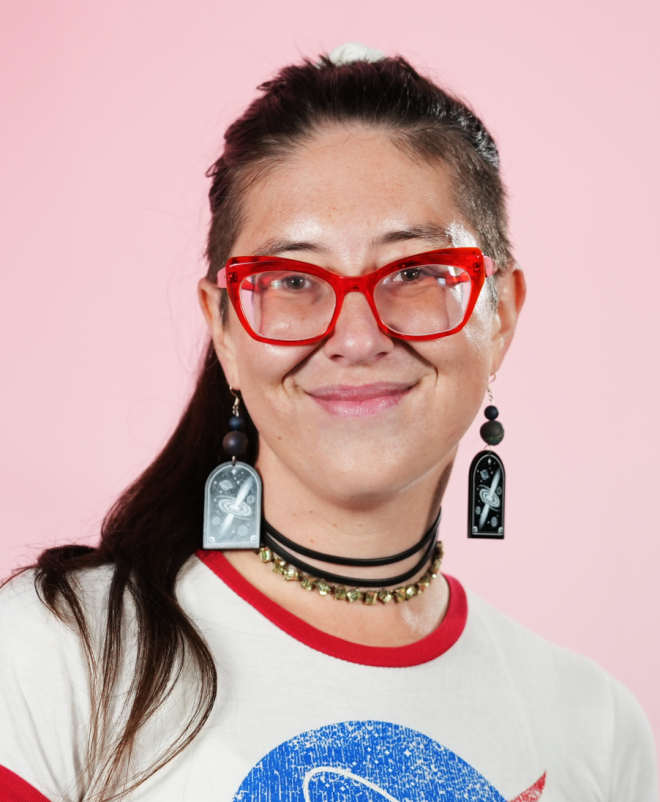
Ibba Armanas is an EMMY-nominated writer/director/producer currently working for KLCS-PBS in Los Angeles. A voracious reader who began narrating fiction podcasts nearly a decade ago, she is now one of three narrators on Inner Space, Outer Thoughts, CALTECH/NASA JPL’s first science-fiction anthology. In her free time, she’s learning to make neon signs and getting way too into hockey.
