

Escape Pod 1030: The Smell of the Planet I Was Born On
The Smell of the Planet I Was Born On
By Rodrigo Culagovski
There are two moons visible, a large one right above us, and another smaller one about fifteen degrees below it in the star-studded night sky above the almost empty, rocky, lifeless surface of the planet. The horizon slowly takes on the slightly blue stain that comes right after the sunset.
“Still takes your breath away, doesn’t it?”
I turn to look up. Laiendro is standing behind me on the slight rise I chose to sit and enjoy the view.
“Yeah, it really does. It’s nothing like Earth, but it’s also the same, you know?”
He doesn’t say anything, just nods and sits down next to me.
Since the air is less dense than it was on Earth, the sky is darker. You can see stars most of the time, except when the terraforming engineers experiment with cloud formation or make the volcanoes release clouds of particles. When the night is clear, like tonight, you can also see the rings starting to come together—unfinished circles glittering in space. That’s where the Homo sapiens flying here right now from Earth on coldships will live, love, and enjoy their lives as they look out over the surface of the planet that will provide food, materials, and open space for whatever they decide to do with it.
We watch in companionable silence as another day’s work ends.
I remember Earth even though I was made fifteen light-years from the birthplace of Homo sapiens. My fellow laborers and I all have the same memories implanted: Mahmed Li, an indentured engineer on the big solarfarms that powered the carbon sinks near the Earth’s equator, when they still thought they could undo the Climate Collapse. Smart and hard-working but not too ambitious, somebody who kept his head down, followed instructions, and did his job quietly. I remember being Mahmed in a distant way, like you might remember a book you read a long time ago.
I was part of the first batch. The sub-lightspeed needleships that carried the recording of Mahmed’s mindstate and the plans for our bodies to Tereshkova-8172d also brought tiny, full-spectrum printers. They sent out bots to mine the surface of the planet for resources and bootstrapped themselves from femto to pico, micro, and milli until they were full-sized machines capable of producing human-sized workers, like me.
They let us choose our names. Most of us invent a completely unique one. I chose “Kaleyé.”
I look like a Homo sapiens—two hands and feet, a head, nose, mouth, ears—but also not. My skin’s color is wrong, it doesn’t bend the right way, and there are no calcium bones underneath. When I smile I have two wide teeth, one on top and one on bottom. I can see a different range of light than sapiens can, hear a wider range of frequencies, and breathe an atmosphere that would them make them curl up like a dead spider. Homo astris was made on and for this planet.
Sixteen-hundred years later, the first three rings are ready, and the other four are half-finished. They circle the planet twice a day in the opposite direction of the planet’s rotation, and are placed in a way that makes them seem to overlap, even though they don’t actually touch each other. The raw materials we launch into orbit are being used to complete the remaining rings and auxiliary stations. My team was in charge of building the magnetic catapults, and every time a speck of light climbs into the sky, I feel a frisson of pride.
We’ve been able to see the ships’ energy plumes for a few months. Seven tiny torches getting bigger and bigger, but one of them looks weaker than the others. We’re just surface-based engineering so we don’t know any details about what’s happening, but Laiendro, who’s on the magcat team with me, is a space-travel buff.
“Looks like trouble,” he says one night as we’re sitting around a small, slow paraffin fire, drinking hot water with caffeine, catechins and polyphenols. The air smells different than when I was born—heavier and with more oxygen, nitrogen, and other gasses. The machines feed us phenotype regulators to help us adapt, but breathing feels slightly strange when you have time to notice it.
Arayix, another member of our team, says, “Ah, what do you know, old man, you’re just a groundworm, like us.” He was built a few centuries ago when the supervisor routines decided to expand the workforce. He calls everybody old man.
Laiendro says, “They have to burn the hydrogen they scooped up on the way from Earth and slow themselves down enough to be captured by the planet’s gravity. That smaller flame? It means they don’t have enough fuel. Something failed in their hydrogen scoop on the way here, and they didn’t notice in time to fix it. They might not make it.”
Arayix scoffs and goes back to the game of Diplomacy that he’s been playing for the past three years with other workers.
“What happens if they don’t get into orbit?” I ask.
“That depends on how fast they’re going and how much reaction mass they have. They might be able to shear off velocity with a low pass around one of the gas giants, maybe even one of the suns, but if they miss that too, they’ll keep going back into interstellar space.”
“So, they’d never wake up, never even know what happened?”
“Well, some of them should be awake by now, getting everything ready. They’ll definitely know what’s happening. The rest, probably not.”
“I’d hate to be one of the ones who are awake.”
“Yeah. Me too.”
We’re silent after that, looking up and wondering about the drama being played out in pinpricks of light in the sky.
With the arrival of the cold ships, nothing changes and everything does.
We’ve always worked for the sapiens, that doesn’t change. We don’t have a choice; they built the machines that keep us alive, and during the millennia we were alone, we couldn’t risk having them stop working if we’d tried to hack them.
Homo astris bodies are industrial-grade and built to last, but our chemistry and biology are, by design, incomplete. If we run out of tetrahydroxyethylamine we feel our cells start to degrade, our oxalylglycine dips low and we can’t think clearly from the pain, and without vitamin B15 we get so weak we eventually can’t move at all.
We know this firsthand because the supervisor routines make us spend a month locked out of the drug machines once every ten years, “So you remember to be careful,” they tell us. The real lesson is clear—do what we’re told.
The six ships take up position near the rings, and the first few thousand sapiens are thawed out. The comm channels are full of chatter in the mix of Mandarin, Spanish, Hindi, Slenglish, and Arabic that was spoken on Earth back when Mahmed was still alive. We were born knowing it, because he spoke it, but our language has drifted a lot in the past sixteen centuries. Our supervisors have made us watch recordings of people from the old days so we remember how to speak with and understand the new arrivals.
I meet my first sapiens. He’s wearing a gravity suit with his name, Agustín Icchavarría, embossed on its left breast pocket. “Hello. I am delighted to meet you all! Jayel, Kaleyé, Ionio, Arayix…” He makes a point of reciting all our names. Maybe he thinks we don’t know he’s reading them off his overlay and we’ll be impressed? He’s too tall, too thin, too pink, and has separate, individual teeth that shine too white when he smiles at us through his faceplate. He spreads his arms in a gesture that seems practiced. Servomuscles strain under the suit’s bright-white cloth to help him lift his arms under three times the gravitational pull he was born under.
He calls Jayel and the other supervisors to join him in the container that the dropshuttle carried from his ship. They spend a long time inside, and when they come out there’s a look on Jayel’s face I haven’t seen before—a mix of anger and defeat.
“Gather round, please, my friends,” says Agustín Icchavarría in his too-loud, too-fast voice. “Your bosses and I had a very fruitful discussion. I’m sure they’ll be happy to fill all of you in on the details. Now, let’s get to work, shall we?” He laughs as if he said something funny.
Nobody tells him that we’ve already been working for the past sixteen hundred years to get the planet ready while he and his people slept. It seems like somebody should.
The sapiens who selected the memories of Mahmed to implant us with couldn’t know—they’d have to have been born with them like we were—but under the compliant, respectful employee they picked as the most likely to produce obedient, useful workers, he fantasized about escaping his indenture, going where he wanted, and living on his own terms. He never spoke of this to anybody, but we remember.
We don’t speak about our own plans, not out loud or in writing—we don’t have to. We leave each other notes and clues and hints that only make sense if you’re one of the almost hundred-thousand hard-working, smart, astris engineers who dream of freedom each night.
We get to work on the machines slowly, gently, learning and testing, advancing in tiny, almost imperceptible steps—never stopping, like a river carving out a valley through a mountain back on old Earth.
It was different when “them” was an idea, something that would arive in some distant future, instead of a sapiens yelling in your face right here, right now, because something failed—and you know it failed because you did what they told you to do, even though you’d explained it wouldn’t work, and you know they know it.
They still want somebody to yell at that can’t yell back at them.
There are more resources now. The coldships were slow, but they also carried a lot more mass than the needleships, including lithium, platinum, tantalum, and other elements that end in “um” that we’ve been unable to find in the Tereshkova-8172 system. This opens up tech trees we hadn’t been able to exploit. Semi-autonomous factories spit out bots of all sizes and shapes by the millions. Solar-panels fill previously untouched basins. Massive power plants are built near volcanoes and rivers, turning geothermal and kinetic energy into microwaves that are beamed to the rings.
Our jobs change. Less designing, preparing, measuring, or monitoring. More rappelling down cooling towers, clambering through exhaust tunnels, or guiding survey bots into active calderas from up close, because volcanoes wreak havoc on remote guidance systems.
It’s dangerous work. Some of us die. Others are damaged, cut, burned, mangled.
Those of us who survive keep working, and we print new Homo astris to replace the ones who don’t.
Agustín Icchavarría, the first overseer to come downplanet, has been dead for one hundred years. His great-grandson, also called Agustín Icchavarría, is in charge of my team now. He’s just as bad as his namesake, maybe even worse because he thinks he’s funny. He wears a seven-pointed star around his neck, and rubs it when he gets nervous.
We’ve worked out a rotation of who’s in charge of taking the service maglev through the newly green, rolling hills, past the tall, svelte towers being grown in Nueva Magallanes to his white mansion for the weekly “sync.” The unlucky worker has to laugh at his attempts at humor and pretend to give serious consideration to his ideas.
The worst part, in my opinion, is when he tells you his conspiracy theories.
“I’m telling you, Kaleyé, think about it. What proof do we have that the ships actually flew through ‘space,’” he makes air quotes. “That they existed at all?”
You can’t really argue with him, his ignorance is too dense and sticky, but you can’t really ignore him or not respond—he gets flustered and cranky. It’s hard to find a middle road, pretending to give his words serious consideration.
I say, “But what about our memories, me and the other workers. We saw the ships come in.”
He makes a dismissive gesture as if my words were insects and he was swatting them away. “What do you remember, some lights in the sky? That could have been easily spoofed with drones.”
“What about the video feeds?”
He laughs his loud, too-many-teethed laugh. “That’s even easier to fake!” He shakes his head and pats mine. “You people need to be more critical, and do your own thinking!”
The ones that come after him blur into each other. Some are a little better, some are worse, but in the long run, it doesn’t make that much of a difference. We keep working.
The seven rings are finished. I understand there was some debate about the last one, as it was intended to accommodate the people of the seventh ship if they’d made it into orbit. The families that run things decided it would be wasteful to not follow the original plan, and divvied up the extra space among their minor clans and major sycophants.
They declare a planet-wide holiday in honor of the “Angels of the Seventh,” an excuse for the sapiens to go out into the wide, green parks under the blue sky—both products and symbols of our centuries of terraforming work—to get drunk and overeat. The air is thick and humid. My skin is sticking to the shirt they printed for us.
“Hey, worker, come over here!”
I turn, slowly. We have orders to mingle with the sapiens, so “We can celebrate together our mutual achievements,” but we’ve managed to stay apart so far.
A tall, thin man walks over to me and throws his oddly-jointed arm over my shoulder.
“Here, buddy, drink up, you deserve it! Without you people, we’d be living in caves and breathing through a hose!”
He pushes a large cup into my face. One of the liquids they enjoy is sloshing around in it. I can smell ethanol and terpene compounds.
“No, thank you,” I say, trying to work myself free from the man’s grasp.
“Drink up! We’re all brother and sisters, and…”
One of his friends yells out, “And whatever they are!” The two men laugh about this.
Sapiens are usually much more polite, at least superficially, but the organic compounds in the liquids they’re drinking clearly impact their social skills. Mahmed didn’t drink, but I remember similar situations when he was cajoled into going to bars with his fellow workers.
I pretend to drink from the cup and laugh at what I think are jokes. I move away as soon as I am physically able to.
It’s been six hundred years since the Homo sapiens arrived. The original seven rings are barely visible among the hundreds of stations, platforms, umbilical systems and other things that orbit the planet. The ships that brought the sapiens here were broken down for parts generations ago. The night sky is full of bright lights moving up and down and around.
I don’t spend much time monitoring their comms systems, but Arayix shows me some of the stranger things they post. The theories the third Ichavarría repeated—I doubt they were his own, he had no imagination—have spread and grown like an untreated yeast infection.
“One group thinks the long trip on the cold ships never happened. Another one that there’s no actual space to travel through in the first place. It’s all connected to the seven-pointed star symbol and the Angels they worship, though I’ve never understood how, exactly. But their theory is: We’re being lied to, there are no spaceships, there never were.”
“Lied to by who? For what reason?”
“If people accept the ‘lie’ about spaceships, they say, then it’s easier to convince people of an even bigger lie.”
“Which is?”
Arayix points down at the ground.
“They think this planet is the Earth, the one where sapiens evolved, and they call it being a completely different planet, and fifteen light years from Earth, the Big Lie.”
“That’s ridiculous,” I say. “There are four moons in the sky. The geomorphology is completely different. There are volcanoes everywhere and no oceans, just the large lakes we’ve built.”
He shrugs. “The scariest part is they won five council seats in the last election. Out of the total thirty-three.”
“Really? Fuck.”
“Yeah, fuck.”
“I give sapiens another two, three generations, tops, before the whole thing grinds to an ugly, screeching stop.”
“At most.”
Arayix and I turn out to be wrong. Human civilization on Tereshkova-8172d lasts for another five generations.
The RealEarth faction isn’t the cause of its downfall, more of a symptom. Trust erodes, the We’re all in this together vibe of the first few hundred years is gone, science and ethics are both equally out of fashion, and long-dormant racial, gender, and religious supremacies vie with each other for power, promising to oppress and disenfranchise whoever their constituencies dislike.
There’s a war. Both sides threaten to lob nukes at the systems that keep the air breathable and volcanoes under control. This is beyond ignorant because it would make the surface of Kova untenable for all sapiens, regardless of their beliefs about gods, gonads, genes, or whatever, but the war itself is built on lies, threats, and spite, so ignorance is to be expected.
Nobody knows who pushes the button, but the nukes fly, the systems break beyond fixing. The conditions on the surface of the planet start to go back to what they where when we were first made, before the cold ships got here.
The Homo sapiens left in the Tereshkova system have to retreat to their bunkers, underground hideyholes, and whatever space hardware remains inhabitable without a stream of planet-grown food. The worldwide computer network sputters, flickers, and breaks.
The great, great, not-so-great grandson of Agustín Icchavarría—who’s inherited the family sinecure and name but insists we call him “GusGusGus”—reads us a short message informing us of the current “problems,” with some vague generalities about everybody “pulling together.” He also repeats the word “humanity” a lot. I’m pretty sure that doesn’t include us. He signs off with, “I wish you all good luck.” Maybe he means it.
We’ve been tracking the sapiens’ downfall for generations, from the moment they set foot on the planet, to be honest, waiting for our time. When the sapiens overseers stop overseeing us—too busy with the decline of their own species to care about us—we put our centuries of plans into motion.
Once we can work openly, it takes us just a few months to finish reverse engineering, modifying, and replicating the machines that make the drugs we need to stay alive.
We no longer need the sapiens to survive.
It’s definitely my imagination, but I feel Mahmed somewhere in the back of my brain.
He’s smiling.
I step out onto the surface of Tereshkova-8172d. Dozens of my brothers stand beside me. Hundreds of thousands repeat the scene in other spots around the planet.
It’s been a few centuries since the sapiens’ cold war grew hot. It was a long, boring, cramped wait, but we are nothing if not patient, and we’ve mapped the areas that are safe for us to reclaim without special gear.
The planet’s atmosphere has almost completely reverted to the way it was in the early days when we got here. The air is thin again and the sky is dark, even at noon. At night, untold numbers of stars shine steady and bright.
Jayel, Ionio, and Arayix are next to me. We grin at each other and walk out onto the surface—quiet, naked, and wide open once again, like it was at the beginning.
I take a deep breath.
I’d missed the smell of the planet I was born on.
Host Commentary
By Mur Lafferty
And that was “The Smell of the Planet I was Born On,” by Rodrigo Culagovski.
If I had to describe this story in one word, it would be patience. This story is on a time scope that most humans can’t comprehend, the Homo Astris people being created not only to survive in environments that could kill humans, but also to build and to not lose their mind over the aeons of their existence. The first narrative time jump is a casual sixteen hundred years; if homo sapiens said that, we’d casually be referring to around half of the recorded human history.
When you look at time like that, then you can afford to be patient through the hurricane of humans’ passions and hasty decisions. Humans are lovers of instant gratification, and waiting a few decades for something would still look like hasty decisions to these folks. Generations of humans go around, feeling superior and advanced, while the Homo Astris folks simply wait.
This story made me think a lot about patience and waiting for bad things to pass. It helps me look at the current state of affairs in the world, actually. But one theme I want to comment on is how you can control people by limiting their choices and making them depend on you. Choices could be anything from control over machines that keep you alive, to getting a job, to reading a book.
Fight censorship, y’all.
Escape Pod is 100% audience supported, and we count on your donations to keep the lights on and the servers humming. Head to https://escapeartists.net/support-ea/ to see all the available donation and subscription options, including Patreon, PayPal, Ko-Fi, and Twitch. We are a 501 c(3) company, so US listeners can possibly write their donations off on their taxes.
You can also support Escape Pod for free by rating or reviewing us on Spotify, Apple Podcasts, or your favorite app. Whether you’ve been a dedicated fan of Escape Pod for years or just started following the cast, thanks for tuning in.
Escape Pod is distributed on a Creative Commons Attribution-NonCommercial-NoDerivatives license. Our music is by permission of Daikaiju. You can hear more from them at daikaiju.org.
That was our show for this week. Our quote comes from Douglas Coupland, “Nothing very very good and nothing very very bad ever lasts for very very long.”
About the Author
Rodrigo Culagovski
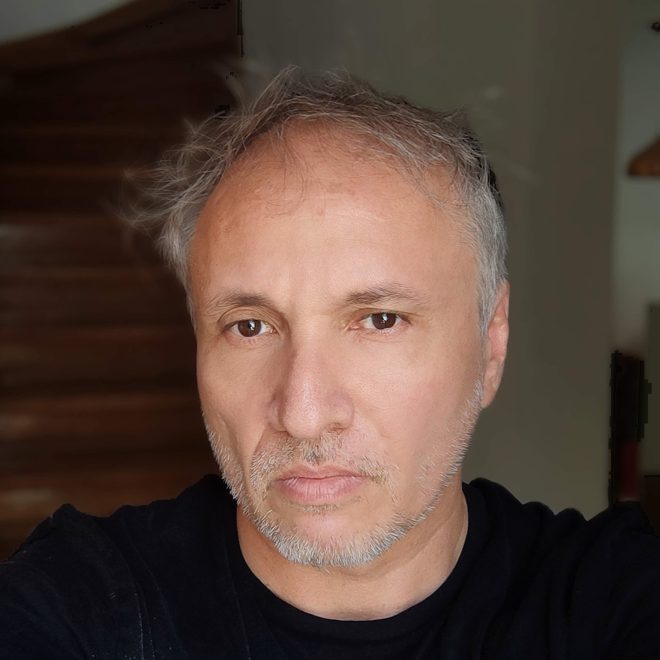
Rodrigo is a Chilean architect, designer, and web developer. He has published in Flash Fiction Online, Nature, Levar Burton Reads, Future Science Fiction Digest, khōréō among others. He misses his Commodore 64. Pronouns he/him/él. SFWA | Codex | ALCiFF On Bluesky as @culagovski.net
About the Narrator
Julia Rios

Julia Rios (they/them) is a queer, Latinx writer, editor, podcaster, and narrator whose fiction, non-fiction, and poetry have appeared in Latin American Literature Today, Lightspeed, and Goblin Fruit, among other places. Their editing work has won multiple awards including the Hugo Award and the Shirley Jackson Award. Julia is a co-host of This is Why We’re Like This, a podcast about the movies we watch in childhood that shape our lives, for better or for worse. They’ve narrated stories for Escape Pod, Podcastle, Pseudopod, and Cast of Wonders.
